
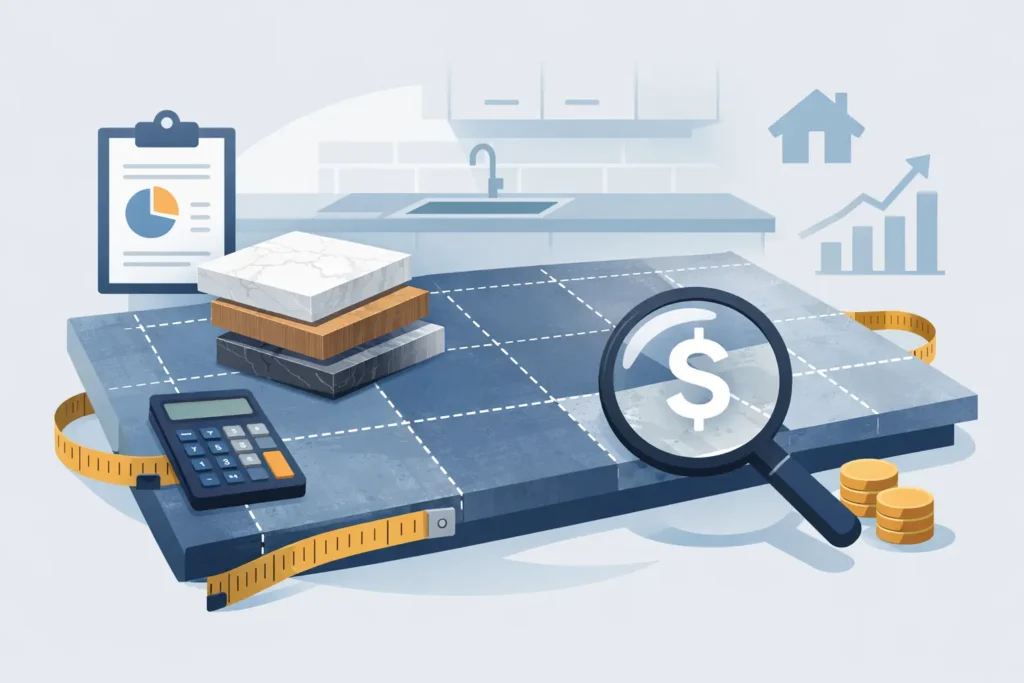
If you’ve started getting countertop quotes around Indianapolis, you’ve probably already noticed something frustrating: one company talks in full slabs, another gives a vague range, and somebody else leaves out half the job until the final invoice. That is exactly why square foot countertop pricing matters. It gives homeowners and property investors a simpler way to understand what they are paying for before the project starts.
For most people, the goal is not to become a stone expert. The goal is to get great-looking countertops, stay on budget, and avoid a process that drags on for weeks. Pricing by the square foot helps with that, but only if you know what the number actually includes and where extra costs can still show up.
What square foot countertop pricing really means
At the basic level, square foot countertop pricing means the cost is based on the amount of finished countertop surface your project needs, not on forcing you to buy an entire slab. That sounds obvious, but in this industry, it is a big deal.
A lot of homeowners assume every countertop company prices this way. Not true. Some suppliers still build pricing around slab availability, waste, and inventory rules that do not work in the customer’s favor. If your kitchen only needs part of a slab, you can end up paying for stone you never use. That is one reason quotes can feel all over the map.
When pricing is truly based on square footage, the process is usually more transparent. You measure the areas, choose your material, and get a quote tied to the actual finished space. That gives you a much cleaner starting point for budgeting a kitchen remodel, bathroom upgrade, rental property refresh, or office breakroom project.
Why this pricing model is easier for homeowners
Most customers are not comparing ten exotic stone grades for fun. They are trying to answer a simple question: what will my countertops cost installed?
Square foot countertop pricing makes that question easier to answer because it connects your layout directly to your budget. If you have 45 square feet of countertop and you choose a material priced at a certain rate per square foot, you can get a realistic estimate faster. That is especially helpful if you are deciding between granite and quartz or trying to keep a remodel inside a lender, insurance, or resale budget.
This model also helps if you are updating a smaller space. A laundry room, vanity, bar top, or condo kitchen may not require a full slab. Paying by the square foot can make those projects much more practical.
There is still some nuance, though. Lower square footage does not always mean dramatically lower total cost. Fabrication, transportation, cutouts, and installation still take labor. A small project can carry a higher cost per square foot in some cases because the fixed work is still there.
What affects square foot countertop pricing
The stone itself is the biggest driver, but it is not the only one. Granite and quartz both come in a wide range of price points based on color, pattern, source, and availability. A common granite color usually costs less than a premium quartz design or a dramatic natural stone with limited supply.
Edge style also matters. A simple eased edge is typically more budget-friendly than a more decorative profile. Sink cutouts, cooktop cutouts, and backsplash pieces add to fabrication time. If you have a large island, mitered edge details, waterfall ends, or unusual angles, the price can move up fast.
Then there is site access. A straightforward ground-level install is different from carrying heavy tops into a tight downtown condo, an upper-floor office suite, or an older home with tricky entry points. Removal of old countertops can be another separate line item, especially if there is tile, laminate with built-up framing, or tops that are difficult to detach without affecting cabinets.
Material finish can play a role too. Polished is common, but leathered or honed finishes can affect availability and labor depending on the stone. And with natural stone, sealing or future resealing is part of the long-term ownership picture.
Granite vs quartz on a per-square-foot basis
This is one of the most common questions we hear because homeowners want a clean answer. The honest answer is that it depends on the specific color and collection.
Granite can be a strong value when you choose from widely available colors. It gives you a natural look with unique movement and variation, and many homeowners still love that one-of-a-kind feel. But some granite colors jump in price because they are harder to source or have more dramatic veining and pattern.
Quartz is often chosen for consistency, easy maintenance, and a more controlled color palette. It is a great fit for busy kitchens, rentals, and modern remodels where customers want a clean, predictable look. But quartz pricing can vary a lot by brand and design. Some entry-level quartz options are very competitive. Premium styles can climb quickly.
That is why browsing pictures online only gets you so far. Two tops that look similar in photos may not price the same at all. Seeing actual slabs or samples tied to a real quote is where the decision starts making sense.
What should be included in the quote
This is where people get burned. A quote that looks cheap at first can end up more expensive if key items are left out.
A good countertop quote should spell out the material, square footage, fabrication, sink or cooktop cutouts, edge details, and installation. If removal, plumbing disconnects, backsplashes, sink upgrades, or sealing are extra, that should be clear up front. You should not have to guess which part of the project is included and which part becomes a surprise later.
Template and measurement work matter too. Early estimates are helpful, but final pricing should be based on accurate field measurements before fabrication. If a company throws out a low number without talking through layout, overhangs, sink selection, or access, be careful.
The cheapest quote is not always the best value. If one number seems way lower than everybody else, there is usually a reason. Sometimes it is because the material is different than you think. Sometimes installation details are excluded. Sometimes you are being quoted on a pricing structure that changes once real measurements happen.
How to compare countertop quotes the smart way
Start by making sure you are comparing the same material category. Not all quartz is equal, and not all granite comes from the same pricing tier. Then look at what each company includes. Are you comparing installed pricing, or just material supply? Are sink cutouts included? What about demolition and haul-away?
Next, ask how the company handles stone selection. That part gets overlooked, but it matters. If you are left to wander a showroom or warehouse on your own, you may waste a lot of time and still not know if the slab you love fits your budget. Hands-on guidance makes the process faster and usually leads to a better result.
It also helps to ask how the pricing model works if your job uses less than a full slab. That single question can tell you a lot. If the answer is vague, keep asking.
Why local process matters just as much as price
A countertop project is not just a material purchase. It is measuring, stone selection, fabrication coordination, scheduling, installation, and problem-solving when real houses do what real houses do. Cabinets are not always perfectly level. Walls are not always straight. Access is not always easy.
That is why a local, service-driven process matters. In markets like Indianapolis, Carmel, Fishers, Greenwood, Avon, and Westfield, homeowners want someone who knows the area, answers the phone, and can guide the job from start to finish without making it complicated.
Granite Networks Indy built its process around that reality. The goal is simple: help customers choose the right stone, price it clearly by the square foot needed, and handle the moving parts so the project does not become a second job for the homeowner.
When square foot pricing is the best fit
This pricing model is especially useful if you want budget clarity early, if your project is smaller than a full slab, or if you are comparing multiple stone options and need to make a decision fast. It is also a smart fit for investors and remodelers who need a repeatable way to estimate projects without chasing showroom appointments all over town.
That said, every job has details. Large kitchens with complex layouts, premium materials, or specialty fabrication will still need careful quoting. Square foot pricing gives you a cleaner framework, but good service is what turns that framework into a finished job without headaches.
If you are shopping for countertops, do not just ask for a number. Ask what the number includes, how the stone is selected, and whether you are paying for the countertop you need or a slab you do not. That one conversation can save you time, money, and a lot of avoidable frustration.