
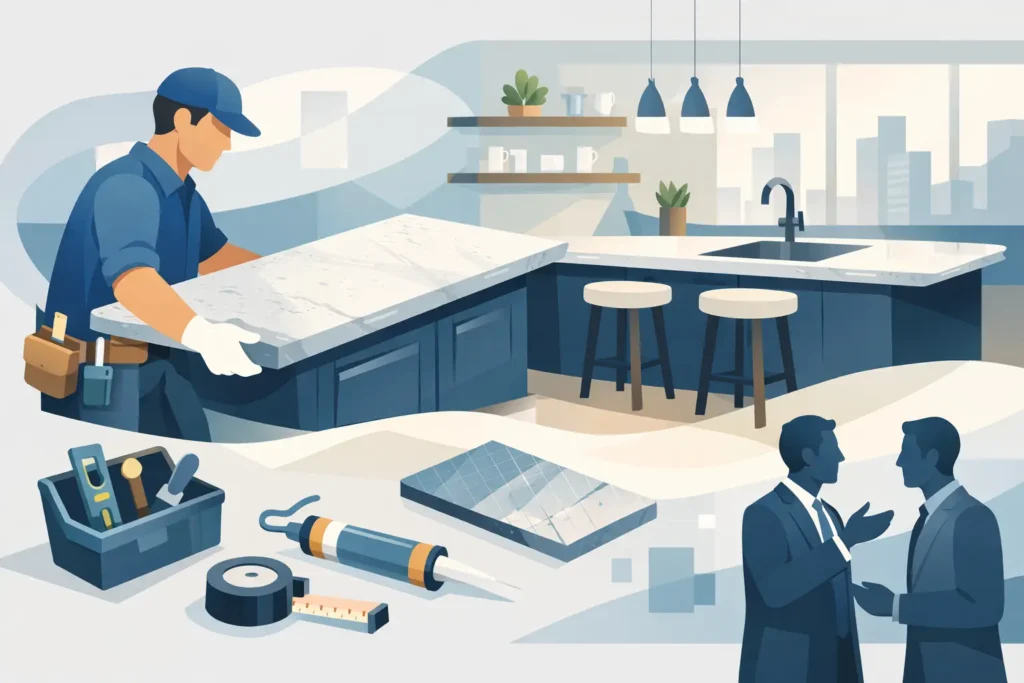
A bad countertop decision shows up fast in a commercial space. Employees lean on it all day, customers see it up close, and cleaning crews put it through the same routine night after night. That is why commercial countertop installation services are not just about getting a slab in place. They are about choosing the right surface, keeping the project moving, and avoiding expensive mistakes that slow down an opening or remodel.
If you own a small office, manage a rental property, run a salon, update a break room, or handle tenant improvements in Indianapolis, you probably do not have time to visit five showrooms and compare six different bids that all price things differently. You want a clear number, practical guidance, and an installer who can tell you what makes sense for the space. That is where a streamlined process matters.
What commercial countertop installation services should actually include
A lot of people hear the word commercial and assume the process is completely different from residential work. Sometimes it is, but not always. The biggest difference is usually the pressure around timing, durability, and consistency across multiple areas.
Good commercial countertop installation services should cover more than installation day. You need accurate measurements, help choosing the right material, fabrication coordination, sink cutout planning if needed, removal of existing tops when applicable, and a realistic installation schedule. If any one of those steps gets sloppy, the job gets harder and more expensive in a hurry.
For smaller commercial projects, the smart approach is usually simple: measure correctly, pick a material that fits the use case, price by the square foot needed, and keep the work moving without a bunch of showroom-style upselling. That saves time, and it usually saves money too.
Choosing the right surface for a commercial space
Not every commercial job needs the same answer. A reception desk has different demands than a break room kitchenette. A rental upgrade has a different budget than a medical office refresh. The best material depends on who uses the space, how hard the surface will get hit, and how much maintenance the owner is willing to deal with.
Quartz for low-maintenance performance
Quartz is a strong fit for a lot of commercial interiors because it gives you a clean look without much upkeep. It does not need sealing, color tends to stay consistent, and it works well in offices, retail counters, salons, and break rooms where owners want a polished finish without adding maintenance tasks later.
That said, quartz is not automatically the answer for every project. If the design calls for a natural look with more movement and variation, quartz can feel a little too uniform. It also helps to think through heat exposure and how the space gets used day to day.
Granite for durability and natural character
Granite still makes a lot of sense in commercial settings, especially when you want a harder natural stone with unique patterning. It handles wear well and gives each installation a one-of-a-kind look. For property owners trying to create a more upscale finish in lobbies, conference areas, or higher-end tenant spaces, granite can be a very strong option.
The trade-off is maintenance. Natural stone may need periodic resealing, and some clients prefer a material with less ongoing care. That does not make granite a bad choice. It just means the material should match the owner, not just the photo they liked online.
Why pricing gets confusing so fast
This is one of the biggest pain points for commercial buyers, especially smaller businesses and local property owners. One company prices by slab. Another gives a low number that does not include cutouts, removal, or edge details. Another sends you to a showroom and expects you to sort through the options yourself before they can even give you a real quote.
That process wastes time. It also makes comparing bids harder than it should be.
A cleaner approach is square-foot pricing based on what the project actually needs. That keeps the estimate more straightforward and helps avoid the feeling that you are paying for material you are not even using. For remodelers and investors trying to control costs across multiple units or phases, that pricing structure matters.
It also helps to work with a company that can guide stone selection at partner warehouses instead of pushing you through a traditional retail showroom model. You still get to see full-size material and make a confident choice, but without all the extra friction.
The process should save time, not add more decisions
Most customers do not need more options. They need the right options.
A practical commercial countertop project usually starts with measurements and a conversation about the space. What is the use? Who is using it? What is the target budget? Does the owner care more about low maintenance, natural appearance, speed, or resale value? Once those answers are clear, material selection gets easier.
From there, the job should move into quoting, fabrication coordination, and installation planning without making the customer chase updates. If a sink is part of the project, that needs to be addressed early. If old countertops need to come out first, that should be handled as part of the schedule, not treated like a surprise add-on at the end.
This is where experience in the Indianapolis market helps. Local scheduling, local suppliers, and local installation crews make a difference when timelines get tight. If you are working around tenant occupancy, business hours, or contractor sequencing, you need realistic answers, not vague promises.
Commercial countertop installation services for different property types
Not every commercial project is a huge build-out. In fact, many jobs are smaller, faster, and more practical than people expect.
A property manager might need durable countertops for a leasing office or clubhouse kitchenette. A salon owner may want a clean, polished work surface that looks professional and wipes down easily. A small medical or dental office might need break room counters and vanity tops that can handle daily use without looking worn six months later. A flipper or investor may be updating mixed-use units and want an attractive finish that helps the property show better without blowing the budget.
These are exactly the kinds of projects where a no-nonsense process pays off. You do not need a luxury design experience. You need solid advice, dependable installation, and pricing that makes sense.
What to ask before hiring an installer
Before you commit to a company, ask how they measure, how they price, and who is handling the installation. Ask whether they help with material selection or leave that entirely up to you. Ask what happens if you need old tops removed, a sink included, or natural stone resealed later.
You should also pay attention to how they communicate. If getting a quote feels confusing, the rest of the project usually does not get easier. The right installer should make the process feel manageable from the first conversation.
That is one reason a hands-on, service-first model works well for local customers. Granite Networks Indy LLC has built its approach around helping people skip the usual showroom runaround, get direct support with stone selection, and pay for the countertop they need rather than a full slab they do not.
Why convenience matters more than people think
Convenience sounds like a bonus until you are the one coordinating trades, answering owner questions, and trying to keep a project on schedule. Then it becomes part of the value.
When commercial countertop installation services are organized well, the customer spends less time chasing answers and fewer dollars fixing preventable mistakes. Measurements are collected correctly. Material options are narrowed down to what actually fits the project. Fabrication gets coordinated without confusion. Installation happens with a plan, not a guess.
That does not mean every project is identical or that every material choice is obvious. Some owners want the natural movement of granite and do not mind resealing. Others want quartz because they never want to think about maintenance again. Some projects are driven by appearance. Others are driven almost entirely by speed and budget. A good installer will tell you when it depends and help you make the right call for the space.
If you are updating a commercial property in Indianapolis or the surrounding areas, the goal is pretty simple. Get a countertop that looks right, performs well, and does not turn into a drawn-out project. The best path there is working with a local team that keeps the process clear, the pricing honest, and the job moving.