
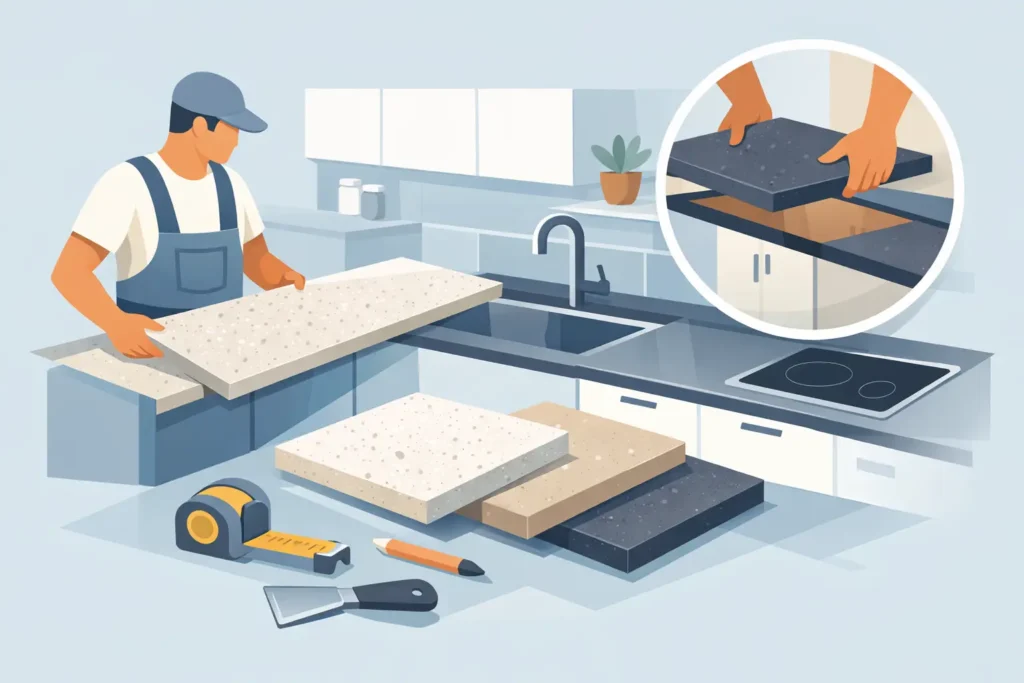
If your kitchen counters are chipped, stained, dated, or just plain frustrating to live with, you do not need a full remodel to make the room feel new again. This kitchen countertop replacement guide is for homeowners around Indianapolis who want a clear path from old tops to a clean, durable finished install without wasting weekends bouncing between showrooms or sorting through vague bids.
A lot of people start with the wrong question. They ask, “What does granite cost?” or “Is quartz better?” Those matter, but the smarter question is this: what kind of countertop replacement fits your kitchen, your timeline, and your budget without creating extra problems? That is where good planning saves money.
What to know before replacing kitchen countertops
Countertop replacement sounds simple until the details show up. Your sink may need to be swapped. Your backsplash may get damaged during removal. Your cabinets might be level enough for one material but not ideal for another. Even the way your kitchen is used matters. A busy family kitchen in Fishers has different wear-and-tear than a quick-turn flip in Greenwood.
That is why the best countertop projects start with measurements, cabinet evaluation, and a real conversation about how you use the space. If you cook every day and want low maintenance, quartz often makes sense. If you love natural movement and want every slab to look unique, granite is still a strong choice. Neither is automatically “better.” It depends on your priorities.
The other thing homeowners often miss is pricing structure. Some companies steer you into full slab pricing even when your kitchen does not require it. That can drive up the total fast. Square-foot pricing is usually easier to understand and easier to compare, especially if you are trying to stay in control of the budget.
Kitchen countertop replacement guide: step by step
Replacing countertops usually goes smoother when you treat it as a process, not a product purchase. The material matters, but the process is what determines whether the job feels easy or turns into a headache.
Step 1: Measure the space the right way
You do not need perfect final dimensions on day one, but you do need a realistic idea of how much surface area you are replacing. That helps narrow budget ranges and tells you whether you are shopping entry-level options or looking at more premium stone.
A rough sketch of the kitchen layout is enough for an early quote. Include sink areas, islands, peninsulas, and any bar tops. Then let a professional handle final field measurements before fabrication. Guesswork at this stage is where bad fits begin.
Step 2: Pick the material based on real life
Granite and quartz are the two surfaces most buyers compare, and both are strong options for Indianapolis-area homes.
Granite gives you a natural stone look with variation, movement, and character that you simply cannot fake. It is heat resistant and durable, but it does need periodic sealing to keep it looking its best. Some homeowners love that natural quality. Others would rather skip the maintenance.
Quartz is engineered, consistent, and easy to live with. It does not require sealing, and it works well for families who want a clean, polished look with less upkeep. The trade-off is that it is not quite the same as owning a natural slab, and extreme heat is not its favorite thing. Hot pans should not go directly on it.
If you are updating a primary residence and want something long-term, choose the surface you actually want to live with. If you are renovating a rental or flip, lean into durability, broad appeal, and price discipline.
Step 3: Select the actual stone, not just the category
This is where many projects go off track. A homeowner says “I want white quartz” or “I want a gray granite,” but those categories can vary a lot. Tone, veining, movement, finish, and edge profile all change the final look.
Seeing the actual slab or inventory selection matters. A sample chip is not the same as looking at the full pattern that will run across your kitchen. This is especially true for granite, where natural variation is part of the appeal. Hands-on stone selection saves a lot of second-guessing later.
Step 4: Confirm what is included in the quote
This part is huge. One quote can look cheaper than another until you realize it does not include removal, sink cutouts, installation, or edge work. Another may leave out plumbing disconnects or haul-away. Suddenly the “deal” is not much of a deal.
A solid quote should clearly explain what you are paying for and what happens next. Ask whether countertop removal is included, whether sink options are part of the process, and whether there are added charges for complex layouts, backsplash sections, or oversized islands. Transparency matters more than a low starting number.
Step 5: Get ready for removal and installation
Once your material is chosen and fabrication is scheduled, the kitchen needs a little prep. Clear counters completely. Empty the base cabinet under the sink. Make sure there is a path for crews to move material safely. If you have fragile flooring or tight entry points, mention it ahead of time.
Removal day is not usually glamorous, but it should be controlled and efficient. Old tops come out, the new surfaces are installed, and sink openings are set based on the final plan. Depending on the scope, you may be without a working kitchen for a short period, so plan meals and water access ahead of time.
How long does countertop replacement take?
The physical installation is usually fast. The full project timeline depends more on selection, measurement, and fabrication than on install day itself.
If you already know what you want and can make decisions quickly, the process can move along nicely. If you are comparing every possible color across multiple warehouses for three weeks, the schedule slows down. There is nothing wrong with taking your time, but it helps to know that indecision usually adds more delay than the actual work.
Material availability also matters. Some colors are easy to source. Others are not. If timing is tight because you are selling a house or trying to finish a remodel, ask early about what is readily available.
Common mistakes this kitchen countertop replacement guide can help you avoid
The biggest mistake is choosing based on price alone. Cheap work has a way of getting expensive when seams are sloppy, measurements are off, or communication disappears halfway through the job.
Another common issue is ignoring the sink and backsplash until the last minute. Your new counters have to work with the whole setup. If the sink needs to be changed, that should be part of the plan from the start. The same goes for faucet holes, overhangs, and edge details.
Homeowners also underestimate how much support helps during selection. Too many options can be just as frustrating as not enough. A straightforward process with guidance cuts down on wasted time and helps you avoid paying for features you do not really need.
Budgeting for replacement without surprises
Most buyers are not looking for the cheapest countertop. They are looking for the best result they can get without getting blindsided on cost. That is reasonable.
Set your budget around the full job, not just the stone. Include material, fabrication, installation, removal, sink-related changes, and any follow-up services like sealing natural stone. If you are replacing counters in an older home, leave a little room for the unexpected. Older kitchens can hide small issues that only show up once tops are removed.
For Indianapolis homeowners, the best value usually comes from a company that can guide measurements, help with stone selection, keep pricing easy to understand, and coordinate the job from start to finish. That is a lot easier than juggling separate suppliers, fabricators, and installers on your own.
Why local process matters
A countertop company that knows the Indianapolis market understands what local buyers care about. In Carmel, maybe you are upgrading for resale in a higher-end neighborhood. In Avon or Greenwood, you may be balancing style and practicality for a family kitchen. In a flip, speed may matter more than chasing a dramatic slab.
That local experience helps with recommendations that actually fit the project. It also helps with communication. When you can get a direct answer, move quickly, and know who is handling the next step, the whole job feels more manageable.
Granite Networks Indy built its process around that exact issue – taking the hassle out, helping customers choose stone without the usual showroom runaround, and pricing work in a way that is easier to follow.
A good countertop replacement should make your kitchen feel better to use every single day. If you keep the process simple, ask the right questions early, and work with people who know how to guide the job from measurement to install, the project gets a whole lot easier.