
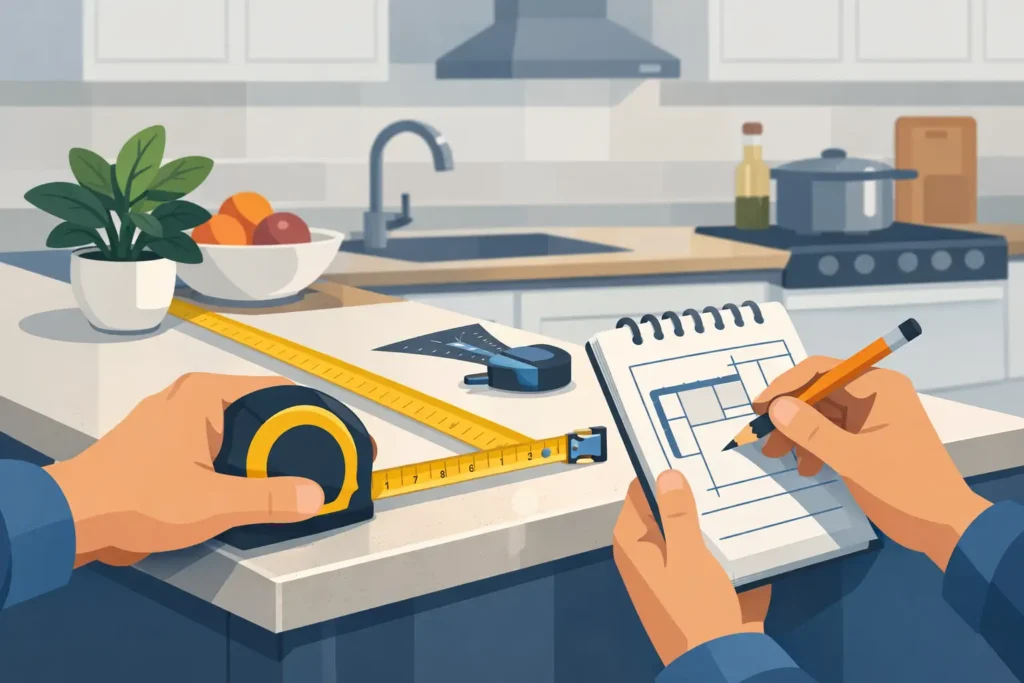
Most countertop quotes go sideways for one simple reason – bad measurements. A cabinet run gets rounded up too much, the island is guessed at, or nobody accounts for the sink section. If you want a faster, more accurate quote and fewer surprises later, knowing how to measure kitchen countertops the right way makes a big difference.
The good news is you do not need to be a fabricator to get a solid preliminary measurement. You just need a tape measure, a basic sketch, and a few minutes of attention. For homeowners in Indianapolis and the surrounding areas, this step is often what turns a vague project into a real number you can plan around.
What you are really measuring
When people talk about countertop measurements, they usually mean square footage. That matters for pricing, especially if you are buying by the square foot instead of being pushed into a full slab. But square footage is only part of the picture.
You are also measuring layout. That includes the length and depth of each section, where corners happen, where appliances break up the run, whether you have an island, and what kind of sink or cooktop opening is involved. A rough measure helps with quoting. A final field measure is what fabricators use before cutting stone.
That distinction matters. Your measurement helps get the project moving, compare options, and set expectations. It is not the same thing as the final template used for fabrication.
How to measure kitchen countertops for a quote
Start by drawing your kitchen from a top-down view. Do not worry about making it pretty. A simple hand sketch is enough as long as each wall, run, and separate surface is easy to identify.
Then measure every countertop section in inches, wall to wall. If you have an L-shaped kitchen, break it into two rectangles. If you have a U-shape, break it into three sections. If you have a bar top or island, draw those separately.
For standard countertop depth, most kitchens use 25.5 inches from the wall to the front edge. That usually includes a slight overhang past the cabinet face. If you have a standard base cabinet layout and you are just trying to get a quote, using 25.5 inches is usually fine. If your tops are deeper than standard, measure the actual depth in each area.
Write down each section like this in your sketch: 96 x 25.5, 54 x 25.5, 72 x 36 for an island, and so on. Keep every piece separate so the layout makes sense later.
Once you have inches, convert each section to square feet by multiplying length x depth and dividing by 144. For example, a section that is 96 inches long and 25.5 inches deep equals 2,448 square inches. Divide that by 144 and you get 17 square feet.
Do that for each section, then add the totals together. That gives you a working square footage number for budgeting.
Measure each section separately, not the whole room
This is where people make the most common mistake. They try to measure the entire kitchen footprint instead of the actual countertop surfaces. That gives you a number that looks official but is not useful.
Countertops should be measured by surface section. If your stove sits between two countertop runs, those are two separate measurements. If your refrigerator breaks the line, stop the measurement there. If your dishwasher sits under the counter, the countertop still spans above it, so include that top section.
Think like the countertop itself, not like the room.
How to handle corners, islands, and peninsulas
Corners are easy if you keep them simple. Measure each leg of the L or U shape as its own rectangle. In a rough quote, that is usually enough. A professional measure will later account for seam placement, backsplash conditions, and whether the corner needs special attention.
Islands need actual depth, not a standard guess. Many islands are wider than standard perimeter tops because they include seating overhangs or extra prep space. Measure the full length and the full depth from end to end.
Peninsulas should also be measured as separate sections, especially if they include seating space. If there is an overhang for stools, measure the full top, not just the cabinet below.
Don’t forget overhangs and exposed ends
A standard front overhang is often already built into a 25.5-inch depth estimate for perimeter cabinets. But side overhangs, raised bars, and seating areas need more attention.
If your island or peninsula has seating, the overhang may be 10 inches, 12 inches, or more depending on support and design. That changes square footage and can affect installation details. The same goes for waterfall edges or decorative end panels. These are not small add-ons. They can change both the amount of stone needed and the final price.
If you are not sure what overhang is possible, do not guess too aggressively. Measure what is there now, or note what you want and ask before locking in pricing.
Sinks, cooktops, and what not to subtract
A lot of homeowners assume they should subtract the sink opening from the total. For countertop quoting, you usually do not subtract sink or cooktop cutouts from square footage. The fabricator still needs that full section of material, and the cutout process is part of the work.
What you should do is mark where the sink, faucet, cooktop, or other openings go. That helps with planning and quoting for cutouts, sink styles, and edge details.
If you are replacing an old top and keeping the same sink base, measure the cabinet width under the sink too. That helps confirm what sink options are realistic.
Backsplash and edge details are separate decisions
When learning how to measure kitchen countertops, some people mix countertop square footage with backsplash square footage. Keep them separate.
A standard 4-inch backsplash can be measured by linear feet along the wall. Full-height backsplash or wall cladding should be measured by height and width like any wall surface. Do not roll it into countertop square footage unless your installer specifically asks for it that way.
Edge profile usually does not change square footage, but it can affect cost. A simple eased edge is not the same as a more decorative profile. That is why a rough measure gets you into the ballpark, but final pricing still depends on the design choices.
A simple example
Let’s say you have one kitchen run that is 120 inches by 25.5 inches, another run that is 84 inches by 25.5 inches, and an island that is 72 inches by 36 inches.
The first section is 21.25 square feet. The second is 14.88 square feet. The island is 18 square feet. Added together, your estimated countertop area is 54.13 square feet.
That is a useful number for budget planning. It is also the kind of information that helps you get a faster quote without waiting for a full site visit just to find out whether the project fits your price range.
Common measuring mistakes that cost people time
The first is rounding too much. Adding a few inches “just to be safe” across every section can inflate your square footage and make the quote look higher than it should. Be precise.
The second is missing separate areas like a coffee bar, desk, laundry counter, or pass-through ledge. Small sections still count.
The third is assuming every top is standard depth. Many are not, especially islands and older kitchens.
The fourth is forgetting that your rough measurement is for estimating, not fabrication. Stone does not forgive bad assumptions. Final templates matter.
When DIY measuring is enough and when it is not
If you are trying to compare granite and quartz options, set a budget, or decide whether now is the right time to replace your countertops, a homeowner measurement is enough to start. It gets you to a realistic quote range quickly.
If you are ordering stone, scheduling fabrication, or changing layout details, professional field measurement is the next step. That is where walls that are slightly out of square, cabinet irregularities, and seam planning get handled properly. In other words, your rough measure helps start the job. The final measure makes sure the job fits.
That is also why a service-first company matters. A good countertop team will not expect you to become a stone templating expert overnight. They will use your rough numbers to guide options and pricing, then take final measurements before fabrication so the install goes smoothly.
The easiest way to make this process less stressful
Take your measurements, sketch the layout clearly, and label anything unusual like an angled corner, farmhouse sink, tall backsplash, or bar overhang. The more complete your notes are, the easier it is to get a quote that actually helps you make a decision.
At Granite Networks Indy, this is exactly the kind of project info that helps keep things simple. You send over the layout, get real guidance, and move toward stone selection and installation without spending weekends bouncing from showroom to showroom.
If you are measuring your kitchen right now, do not aim for perfection. Aim for clear, honest numbers that show the shape of the job. That is usually all it takes to turn a maybe-later project into one you can finally put in motion.