
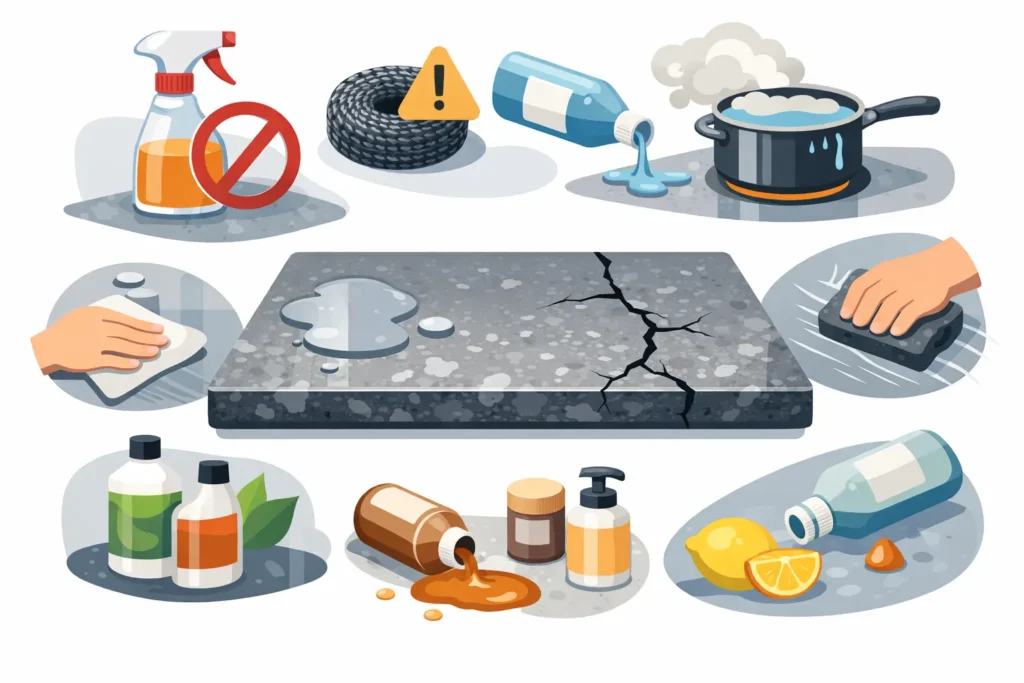
A granite top can handle busy family kitchens, rental-property turnovers, and plenty of meal prep. What it cannot handle is being treated like every other countertop. Most granite countertop care mistakes start with good intentions: a homeowner grabs a strong cleaner, skips sealing because the stone still looks fine, or leaves a wet dish towel by the sink for days. Small habits can dull the finish, stain porous areas, or leave the stone looking older than it should.
The good news is that granite care is not complicated. You do not need a cabinet full of specialty products or a weekend maintenance routine. You just need to avoid the habits that cause the most trouble and know when a professional reseal makes sense.
1. Using vinegar, lemon, or harsh all-purpose cleaners
Granite is a natural stone, not a plastic laminate. Acidic cleaners such as vinegar, lemon juice, lime juice, and many bathroom cleaners can slowly wear down the protective sealer. Over time, that can make the surface look hazy and less resistant to staining.
The same goes for cleaners containing bleach, ammonia, or abrasive powders. One quick wipe may not cause an obvious problem, but repeated use is where homeowners get caught. A countertop can look clean while its protective barrier is being weakened.
For regular cleanup, use warm water, a soft cloth, and a small amount of mild dish soap. Follow with a clean, dry microfiber cloth so residue does not build up. If you want a stone cleaner, choose one clearly labeled as safe for natural stone. Simple works best here.
2. Letting spills sit near the sink or cooktop
Granite is durable, but some varieties are more porous than others. Darker granite can be dense and forgiving, while lighter colors or stones with more movement may need more attention. That is why care always depends somewhat on the specific slab you selected.
Oil, cooking grease, red wine, coffee, fruit juice, and standing water are the spills worth handling quickly. Water itself usually will not permanently stain granite, but repeated moisture around the sink can darken an unsealed area or create a temporary wet-looking spot.
Blot spills instead of aggressively scrubbing them. Scrubbing can spread oil or pigment across a wider area. Once the spill is lifted, clean the area with mild soap and water, then dry it fully. A paper towel under a wet soap dispenser or dish rack is a small move that can prevent a lot of sink-area frustration.
3. Assuming granite never needs to be sealed
This is one of the most common granite countertop care mistakes because granite has a reputation for being nearly indestructible. It is tough, but it is still natural stone. Many granite countertops benefit from periodic sealing to help resist moisture and stains.
How often? There is no one-size-fits-all schedule. The type of granite, the original sealer, kitchen use, and cleaning habits all matter. A busy household that cooks every night may need attention sooner than a low-use guest kitchen. Some dense stones can go much longer between sealing services.
A simple water test can give you a clue. Put a few drops of water in an inconspicuous spot and let them sit for about 15 minutes. If the stone darkens or absorbs the water instead of beading it up, it may be time to reseal. Do not panic if you see a darker spot. It often dries out, but it is a sign that the protective sealer may be wearing thin.
Professional resealing is a smart choice when you are unsure of the stone type, have visible staining, or want the work handled correctly without guessing at products. The wrong sealer or poor application can leave streaks, residue, and an uneven finish.
4. Cutting directly on the countertop
Granite is harder than most kitchen knives, which makes it feel like a convenient cutting surface. It is not a good one. Your granite may survive the knife better than the blade does, but repeated cutting can dull knives quickly. It can also create unnecessary wear around seams, edges, and high-use areas.
Use a cutting board for chopping, slicing, and food prep. This protects your knives and keeps raw food off the stone surface. It is also easier to clean and sanitize a cutting board after handling raw meat than to keep wiping down a large countertop.
The same common-sense rule applies to heavy impacts. Granite handles everyday use well, but dropping a cast-iron skillet on an edge or corner can chip the stone. Edges are the most vulnerable part of any countertop installation, especially around an overhang, island corner, or cooktop cutout.
5. Leaving hot pans where they land
Granite has excellent heat resistance, and that is one reason Indianapolis homeowners choose it for hardworking kitchens. Still, heat resistant does not mean heat proof in every situation. A very hot pan can stress the stone if the countertop is already cold, if the heat is concentrated in one spot, or if there is a seam nearby.
There is another issue: countertop seams, caulk, and anything placed on top of the granite may not tolerate the same heat as the stone itself. A hot pan can damage a trivet with rubber feet, discolor an item beneath it, or create problems near an undermount sink seam.
Use a trivet or hot pad. It takes two seconds and removes the guesswork. Granite is built for real kitchens, but good habits keep it looking like a recent upgrade instead of a surface that has been through a decade of hard use.
6. Using rough scrubbers and scraping tools
A dried-on mess can make anyone reach for a scouring pad. Resist the urge. Steel wool, rough abrasive pads, and aggressive scraping can scratch the sealer, dull polished areas, and leave marks that show up in certain lighting.
For stuck-on food, lay a warm, damp cloth over the spot for a few minutes to soften it. Then use a plastic scraper or a nonabrasive pad with mild soap. Work patiently instead of forcing it. If you are dealing with a stubborn ring, an oil stain, or a mark that will not lift, stop experimenting with random cleaners from under the sink. A stone professional can identify whether it is a surface issue, a stain in the pores, or damage to the sealer.
7. Ignoring changes in the surface
Granite does not usually fail without giving you a sign. A dull patch near the sink, darkening around a faucet, a rough spot on an edge, or water that no longer beads can all point to a maintenance need. The earlier you address it, the simpler the fix tends to be.
Pay attention to seams, too. A seam should be secure and smooth enough for normal use, but it is not meant to become a standing-water zone. Wipe up water around seams and avoid letting cleaners pool there. If you notice movement, separation, or a chip near a seam, have it checked instead of trying to fill it with a hardware-store product.
A simple granite care routine that actually works
For most homes, daily care is straightforward: wipe crumbs and spills with a soft cloth, clean with mild soap and water when needed, and dry the surface afterward. Use cutting boards and trivets, especially in the busiest parts of the kitchen. Once or twice a year, do the water test in a low-visibility area to see how the sealer is holding up.
That routine is enough for most granite tops. You do not need to baby the stone, but you also should not use it as a cutting board, cooling rack, or testing ground for harsh cleaning products. The goal is to protect the finish and keep the stone easy to live with.
If your granite is looking dull, absorbing water, or showing a stain you cannot identify, getting a local opinion can save you from making the repair worse. Granite Networks Indy can help homeowners figure out whether a countertop needs a simple reseal, a targeted repair, or just a better care routine. A few practical changes now can keep your kitchen looking sharp for years.