
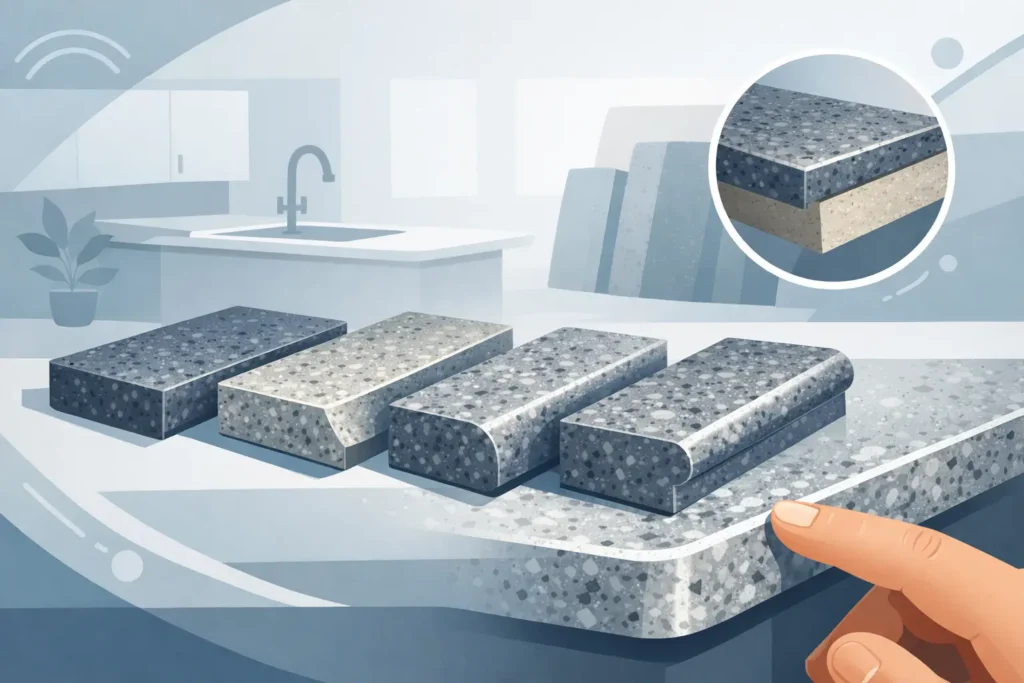
One of the fastest ways to change the look of a kitchen without changing the stone itself is the edge. That is why granite countertop edge options matter more than most people expect. You can pick the same color slab, install it in the same room, and get a totally different finished look just by changing the profile along the front.
This is where a lot of Indianapolis homeowners get stuck. They choose the granite color, think they are basically done, and then hit a wall when someone asks whether they want eased, bevel, bullnose, or ogee. If those names sound familiar but not exactly clear, you are not alone. The good news is that edge selection does not need to turn into another drawn-out showroom decision.
Why granite countertop edge options matter
An edge profile affects three things right away – appearance, function, and price. Some edges look clean and simple, which works well in updated kitchens, rentals, and flips where you want timeless appeal. Others feel more decorative and traditional, which can make sense in larger homes or spaces with detailed cabinets and trim.
Function matters just as much. A rounded edge is usually a little more forgiving in a busy family kitchen. A sharper profile can look great, but it may not be the best fit if kids are constantly cutting corners around an island. Cleaning is another factor. Some profiles have more grooves or tighter curves, which can collect crumbs and need a little more attention.
Then there is fabrication cost. Basic edges are typically included or priced more favorably, while decorative profiles usually cost more because they take more labor and precision. If you are trying to keep the project moving and the budget under control, the edge choice should be part of the conversation early.
The most common granite countertop edge options
Most homeowners do not need twenty choices. They need the few that actually make sense for their home, budget, and style. These are the profiles people ask about most often.
Eased edge
An eased edge is one of the most popular options because it is simple, clean, and easy to live with. It is basically a straight edge with the sharpness softened slightly. That small detail gives the countertop a crisp look without leaving a hard corner that feels too severe.
If you want a modern or transitional kitchen, this is usually a safe pick. It also works well if you are selling a home or updating a rental because it appeals to a lot of buyers without drawing too much attention to itself. Another practical upside is easier cleaning. There are no deep curves or decorative cuts trapping dust or grease.
Pencil edge
A pencil edge has a slightly more rounded top than an eased edge. It still looks fairly simple, but it softens the overall profile a bit more. This can be a nice middle ground if you want something subtle that does not feel too square.
For many kitchens, this is a smart everyday choice. It looks polished, feels comfortable, and does not push the design too modern or too traditional.
Half bullnose
A half bullnose rounds the top edge while the bottom stays more straight. It gives the countertop a softer appearance from the front without becoming fully rounded.
This profile works well when homeowners want a little more shape than an eased edge but still want a fairly practical surface. Water tends to roll off the rounded top more easily, which some people like, but it can also drip over the front if there is a lot of splashing near the sink. That is not a deal breaker, just something to know.
Full bullnose
A full bullnose is rounded on both the top and bottom, creating a very smooth, curved front edge. This was especially popular in many traditional kitchens and still has its place today.
The biggest advantage is safety and softness. There are no sharp corners at the front, which can be appealing in homes with kids. The trade-off is visual style. In some kitchens, a full bullnose can feel a little more classic than current. If you are after a sharper, cleaner look, another profile may fit better.
Bevel edge
A bevel edge has a flat angled cut along the top corner. It adds more definition than an eased edge and can give granite a slightly more formal appearance.
This is a good option if you want something decorative without going too ornate. It catches light differently than a rounded edge, so it can highlight the movement and polish in the stone. On the downside, the angle can show chips a little more noticeably over time if the countertop gets hard use.
Ogee edge
An ogee edge is one of the more decorative granite countertop edge options. It has an S-shaped curve that creates a more upscale, furniture-style appearance.
This profile makes the biggest impact in larger kitchens, traditional homes, and spaces where the countertop is meant to stand out. It can look great on islands or statement vanities. It is not always the best fit for every project, though. Ogee edges usually cost more, and they require more cleaning attention because of the curves. If your goal is speed, simplicity, and easy maintenance, this may not be the one.
How to choose the right edge for your kitchen
The best edge is not about picking the fanciest profile. It is about choosing what fits the room and how you actually use it.
Start with the cabinet style. Shaker cabinets, flat-panel doors, and cleaner design lines usually pair well with eased, pencil, or a modest bevel. More detailed cabinets can support a fuller profile like ogee or bullnose. If the kitchen already has a lot going on in the backsplash, flooring, or door trim, a simpler edge often keeps the room from feeling too busy.
Think about the thickness of the countertop too. A profile can look very different depending on the stone thickness and the overall scale of the kitchen. A decorative edge in a small kitchen can sometimes feel like too much. In a larger kitchen with a substantial island, it may feel balanced.
Daily use matters more than people think. If this is a family kitchen where lunch boxes, grocery bags, and homework all hit the countertops every day, simple usually wins. If it is a powder bath vanity or a bar top that is more about looks than heavy use, you have a little more freedom to choose something more detailed.
Price differences and where homeowners overspend
Edge upgrades can be worth it, but they are not always the smartest place to spend money. A lot of homeowners get more value by putting that budget toward a better slab, a larger island overhang, or a sink upgrade instead of a highly decorative edge.
That does not mean upgraded edges are a bad idea. It just depends on the project. In a high-end custom kitchen, a premium profile may make sense because it matches the rest of the finish level. In a flip, rental, or budget-conscious remodel, a simple edge often gives the best return because it looks clean and avoids adding cost that buyers may not notice.
This is where straightforward pricing matters. If you are comparing bids, ask whether the quoted edge is basic or upgraded and exactly what profile is included. Homeowners sometimes think they are comparing the same countertop package when they are not.
What works best for Indianapolis-area homes
Around Indianapolis, Carmel, Fishers, Greenwood, Avon, and Westfield, the most practical choices tend to be eased, pencil, and bevel edges. They fit a wide range of home styles, from updated suburban kitchens to investment properties that need a durable, attractive finish without unnecessary extras.
Ogee and full bullnose still have their place, especially in more traditional homes or larger remodels where the design leans formal. But for many local projects, simpler edges make the process easier and keep the final look current.
That is also why hands-on guidance helps. At Granite Networks Indy, we walk customers through these choices in plain language so they do not waste time guessing or get pushed toward upgrades that do not fit their goals. When you already have measurements, a stone direction, and a real budget in mind, edge selection becomes much easier.
A quick rule of thumb before you decide
If you want the safest all-around answer, choose an eased or pencil edge. If you want a little more visual detail, look at bevel or half bullnose. If you want a more formal statement and do not mind paying more for fabrication and upkeep, consider ogee.
The right countertop edge should make the whole kitchen feel finished, not complicated. If you are stuck between two options, the better choice is usually the one that fits your cabinets, your budget, and how you actually live in the space every day.