
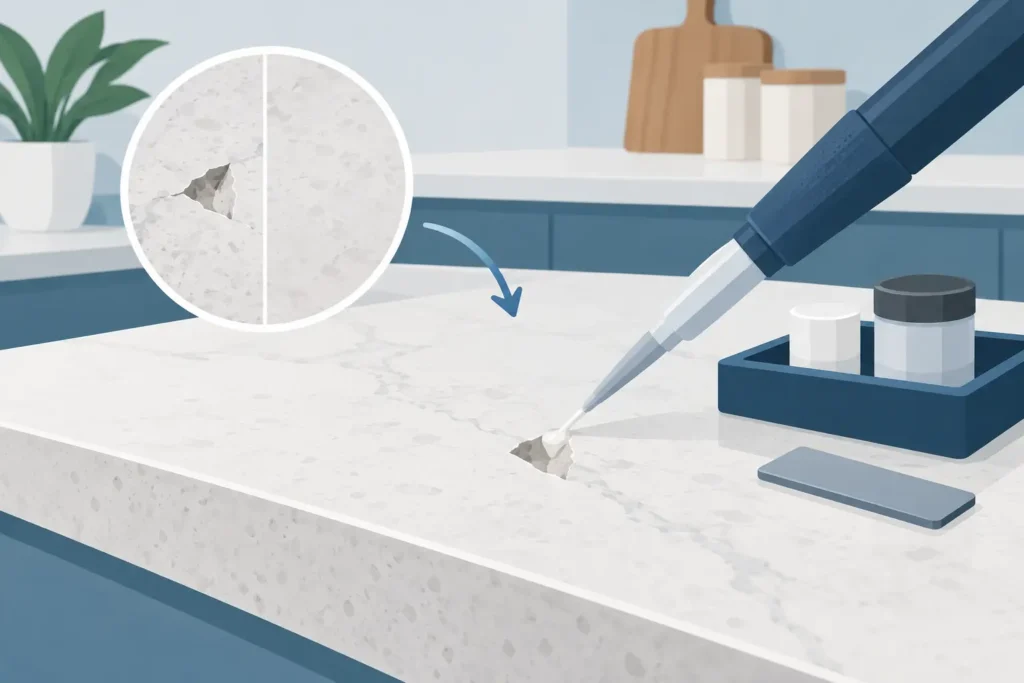
A chipped quartz countertop can feel like a major problem the second you spot it, especially when it is on a new kitchen island or a highly visible edge. The good news is that quartz chip repair is often possible. The less convenient truth is that a repair is not always invisible, and the right fix depends on where the chip is, how deep it goes, and how the countertop was damaged in the first place.
For homeowners in Indianapolis, Carmel, Fishers, Greenwood, Avon, and Westfield, the goal is usually simple: stop the damage from getting worse and get the counter looking right again without turning a small issue into an unnecessary replacement project. Here is the straight answer on what can be repaired, what should be left alone, and when it is time to call a countertop professional.
Why Quartz Chips in the First Place
Quartz is durable, but it is not indestructible. Engineered quartz countertops are made from natural quartz minerals combined with resins and pigments. That combination makes them nonporous, easy to clean, and a strong choice for busy kitchens. It does not make them immune to a hard impact.
Most chips happen at exposed edges. A heavy cast-iron skillet slips from a cabinet, a glass bottle hits the corner of the island, or something hard gets dropped near the sink cutout. The edge takes the hit because it has less support than the center of the countertop.
Corners, overhangs, and areas around cooktops and sinks are also more vulnerable. A chip can occasionally show up after installation if a countertop was struck during another part of a remodel. It may not be anyone’s favorite discovery, but it is usually more manageable than homeowners expect.
Heat is another concern. Quartz can handle normal kitchen use, but direct high heat from a hot pan can damage the resin in the surface. That may create discoloration, cracking, or a rough spot that looks different from a basic impact chip. Those problems require a different conversation than a small edge nick.
Can Quartz Chip Repair Look Invisible?
Sometimes it can look very close. Sometimes it cannot. Anyone promising that every repair will disappear completely is setting the wrong expectation.
A professional repair technician typically cleans the damaged area, removes loose material, color-matches a resin or epoxy filler, fills the missing section, then shapes and polishes the repair. On a solid white, black, or consistent-color quartz, a small repair can blend in very well. On heavily veined quartz, the technician may have to recreate movement and color variation by hand. That takes more skill, and even a good repair may still be visible when you know exactly where to look.
Location matters just as much as color. A small chip on the underside of an edge or along the back of a countertop is usually easy to live with. A chip on the front corner of a waterfall island, where light catches it every day, is more difficult to disguise.
The practical standard is not always invisibility. It is a smooth, stable repair that does not collect grime, snag a cloth, or continue breaking away. For many homeowners, that is a very worthwhile result.
When a Chip Is a Good Candidate for Repair
Small, localized damage is usually the best situation. If a piece of surface material has chipped away but the countertop itself is stable, a repair can often restore the edge and protect it from further damage.
A repair makes sense when the chip is limited to one spot, there are no cracks running outward from it, and the affected area is not loose or separating from the slab. Minor sink-edge chips are also commonly repairable, although they should be addressed sooner rather than later because that area sees water, cleaning products, and frequent use.
It is also smart to repair a chip before selling a home or listing a flip. A small countertop flaw can stand out during showings and make buyers wonder whether there are larger issues. A clean repair is often far less expensive and disruptive than replacing a full section of quartz just to correct one damaged corner.
Damage That Needs a Closer Look
Not every broken spot should be filled and forgotten. A long crack, a separated seam, a damaged cooktop cutout, or a chip that keeps growing can point to a larger issue. The countertop may have insufficient support, movement in the cabinets, stress from an overhang, or damage caused by heat.
In those cases, a cosmetic filler alone may hide the symptom without correcting the reason it happened. A countertop professional should inspect the area and determine whether reinforcement, seam work, or replacement is the smarter move.
Do Not Turn a Small Chip Into a Bigger Repair
The biggest mistake we see is homeowners attacking a chip with the wrong DIY material. Super glue, hardware-store caulk, and random clear epoxy can dry yellow, leave a raised bump, or create a dull patch that is more obvious than the original damage.
Quartz repair kits can work for tiny, low-visibility chips, especially for someone comfortable with detail work. But color matching is the hard part. Quartz is not always one flat color, even when it looks simple from across the room. The finish also matters. A polished top needs a different result than a honed or matte surface.
If you decide to wait for a professional, keep the area clean and dry. Save any larger broken piece if you still have it, but do not force it back into place. Avoid dragging heavy items over the damaged edge and do not use abrasive pads or harsh chemicals around the chip.
A little caution now can preserve the area for a cleaner repair later.
What a Professional Quartz Chip Repair Process Looks Like
The process should start with a clear look at the damage, not a guess over the phone. Photos can help identify whether a repair is likely, but an in-person assessment may be needed for chips near seams, sinks, cooktops, or unsupported overhangs.
Once the damage is confirmed as repairable, the area is cleaned and prepared so the repair material bonds properly. The technician builds color in layers when needed, fills the chip, lets the material cure, then carefully levels and polishes it to match the surrounding surface. This is precise work. Taking off too much material or using the wrong polishing method can leave a cloudy spot around the repair.
For a simple chip, the actual work may be relatively quick. More complicated repairs take longer because matching veining, depth, and gloss takes patience. If a countertop has a large broken corner or a crack that crosses the slab, the conversation shifts from repair time to whether a replacement piece is more dependable.
Preventing Future Quartz Edge Damage
You do not need to treat quartz like it is fragile. Just protect the places that take the most abuse. Use a trivet for very hot cookware, especially cast iron and roasting pans. Do not use the countertop as a cutting board. Keep heavy small appliances from being slammed into corners, and be careful when loading or unloading items near the sink.
For families with busy kitchens, the front edge of the island is often the real danger zone. Kids climbing onto stools, grocery bags getting dropped, and pans being moved around quickly can all lead to accidental impacts. A little awareness goes a long way.
If you are choosing new quartz, talk through the edge profile before fabrication. A softened or rounded edge can be more forgiving than a sharp square profile in a high-traffic kitchen. That does not mean one option is always better. A square edge gives a cleaner, modern look, while eased and rounded edges can be a practical choice for active households and rental properties.
When Replacement Is the Better Call
Replacement may be the better investment when damage affects structural integrity or appears in a highly visible place where a repair will not meet your expectations. Large fractures, major heat damage, broken sink rails, and extensive edge loss are examples where patching may not deliver a long-term result.
This is where working with a local countertop company helps. Granite Networks Indy can help homeowners look at the full picture, from the condition of the existing quartz to whether replacing one section is practical and what a new piece will cost. You should not have to buy a full slab just because one part of a countertop needs attention.
A chip does not automatically mean your quartz countertop is ruined. Get the damage evaluated early, use realistic expectations about color matching, and choose the fix that makes sense for your kitchen, budget, and timeline. The best repair is the one that lets you get back to using your kitchen without staring at that damaged spot every time you walk by.