
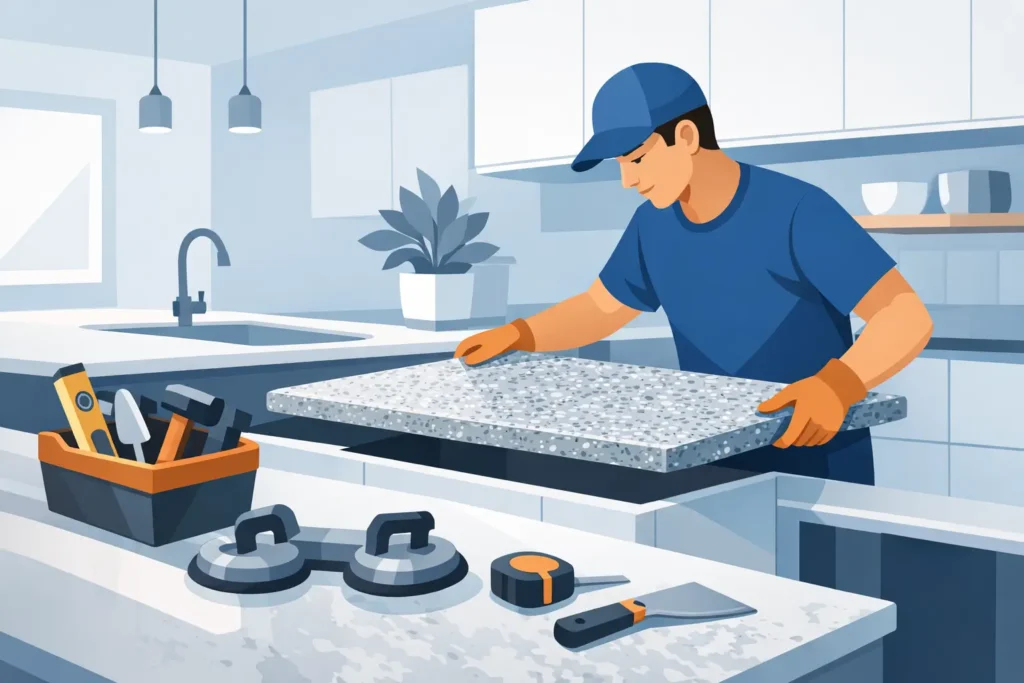
A lot of homeowners ask this right after they see an installation quote – can you install granite countertops yourself and save a few thousand dollars? Technically, yes. Realistically, only sometimes. Granite is not like installing a vanity top from a big box store. It is heavy, brittle in the wrong spots, expensive to replace, and very unforgiving if measurements are even a little off.
That does not mean DIY is impossible. It means the decision should be based on the job you actually have, not on a weekend-renovation video that skips the hard parts. If you are looking at a small straight run with no sink cutout, no cooktop, and easy access, the answer is different than it is for a full kitchen with seams, corners, overhangs, and an undermount sink.
Can You Install Granite Countertops Yourself for a Full Kitchen?
For a full kitchen, most people should not. That is the honest answer.
The biggest reason is not just weight, although that matters. A single granite section can weigh hundreds of pounds. The bigger issue is that kitchen layouts create weak points. Sink openings, cooktop cutouts, narrow strips behind sinks, and long spans all increase the odds of cracking during transport or set-in-place. One awkward turn through a doorway or one cabinet that is slightly out of level can turn an expensive slab into a loss.
Professional installers are not just showing up to drop stone on cabinets. They are checking support, confirming fit, handling seams, leveling sections, fastening sinks correctly, and making sure the finished top sits flat without stress. When granite breaks, it usually does not happen because the material is bad. It happens because the handling, support, or layout was off somewhere in the process.
If your kitchen has an L-shape, a large island, a farmhouse sink, or multiple cutouts, DIY gets risky fast. You may still be able to manage parts of the project yourself, like demolition or prep work, but the actual install is usually where homeowners decide the savings are not worth the gamble.
What DIY Granite Installation Really Involves
People tend to picture the install as the main event, but the work starts way before that.
First comes measuring, and this is where many jobs go sideways. Granite is fabricated from templates or precise dimensions, not guesses. Walls are rarely perfectly square, cabinets can vary, and overhangs need to be intentional. If your measurements are off, the slab will not magically flex into place.
Then there is stone selection and fabrication. A raw slab is not a countertop yet. It needs to be cut, polished, and finished based on your layout. Cutouts for sinks and cooktops need to be exact. Edge profiles need to be selected. Seams need to be planned where they will hold properly and look as clean as possible.
Once fabrication is done, transportation becomes the next challenge. Granite must be moved upright, secured correctly, and handled carefully. A lot of DIY plans start strong and fall apart here, because moving stone safely takes the right equipment and enough experienced hands.
The final install still requires cabinets that are level and structurally sound, proper shimming, seam joining, sink mounting, faucet-hole alignment, and backsplash coordination if that is part of the project. None of these tasks are impossible on their own. Together, they are a lot more technical than most homeowners expect.
The tools are not the whole story
Some people assume they can rent the tools and be fine. Tools help, but they do not replace experience. Suction cups, seam setters, shims, adhesive, support rails, and polishing tools matter, but knowing when the slab is under stress matters more.
That is why granite is one of those jobs where mistakes are expensive very quickly. A flooring mistake might mean replacing a few boxes of material. A granite mistake might mean replacing a fabricated piece that took time to source, cut, and deliver.
When a DIY Granite Install Might Actually Make Sense
There are a few situations where DIY can be reasonable.
If you are installing a small remnant top in a laundry room, bar area, powder room, or simple outdoor space, the job can be manageable. The same goes for a short, straight piece with no sink cutout and no seam. If access is easy and the cabinets are already level, the risk drops a lot.
This is also more realistic for experienced remodelers or flippers who already work with heavy materials and understand cabinet prep. Even then, most experienced people know where to draw the line. A basic top is one thing. A large kitchen with multiple finished pieces is another.
If you are asking because you want to control the budget, that makes sense. Just make sure you compare true costs, not just the labor line on a quote. DIY often adds rental costs, extra help, possible material loss, disposal, and lost time if something needs to be redone.
Where DIY Granite Projects Usually Go Wrong
The most common issue is bad measuring. Homeowners often measure cabinet length and assume that is enough. It is not. You also need to account for wall variation, appliance spacing, reveal, overhang, and where seams can actually work.
The next problem is cabinet prep. Granite needs solid, level support. If the cabinets are twisted or uneven, the stone can be forced into stress points. Sometimes the problem does not show up on install day. It shows up weeks later as a crack near a sink or corner.
Sink areas are another major trouble spot. Undermount sinks need secure mounting and support. Faucet holes need proper spacing. The stone around the sink cutout is one of the weakest parts of the slab during handling.
Then there is the assumption that “close enough” will work. It usually will not. Granite does not forgive sloppy prep, and once fabrication is done, your options get limited.
Why Professional Installation Often Saves Money
This is the part people do not always expect. Hiring a pro can be the cheaper move.
Not because labor is free, obviously. It is because experienced installation lowers the risk of replacement, delay, and rework. When a company handles measurement, fabrication coordination, delivery, and install as one process, there are fewer handoff mistakes. That matters more than most people realize.
You are also paying for efficiency. A solid crew can do in a few hours what might take a homeowner days of planning, lifting, adjusting, and troubleshooting. If you are remodeling a kitchen in Indianapolis, Carmel, Fishers, or Greenwood, time matters. The longer your kitchen is down, the more stressful the project gets.
This is one reason a lot of customers decide they want help even if they are comfortable doing other parts of the remodel themselves. They will paint cabinets, swap hardware, or handle demolition, but leave the stone install to people who do it every week.
A better middle ground for budget-conscious homeowners
If your goal is saving money, the smartest route is often not full DIY. It is choosing a streamlined installation process with clear pricing.
That means getting accurate measurements, selecting from available slabs efficiently, and paying for the square footage you need instead of getting pushed into a more complicated buying process. Granite Networks Indy is built around that kind of approach because most homeowners are not looking for a showroom marathon. They want straight answers, fair pricing, and a finished countertop that looks right the first time.
So, can you install granite countertops yourself?
Yes, in some cases. But the better question is whether you should.
If this is a small, simple project and you have experience handling heavy finished materials, DIY may be worth considering. If this is your main kitchen and the job includes cutouts, seams, corners, or a large island, professional installation is usually the safer and smarter move.
There is no prize for making your countertop project harder than it needs to be. Granite should add value to your home, not create a repair bill before you ever use the sink. If you want the best result, focus less on whether DIY is technically possible and more on what gives you the cleanest install with the least risk.
A good countertop job should feel solid, look clean, and be one less thing to worry about once the kitchen is back together.