
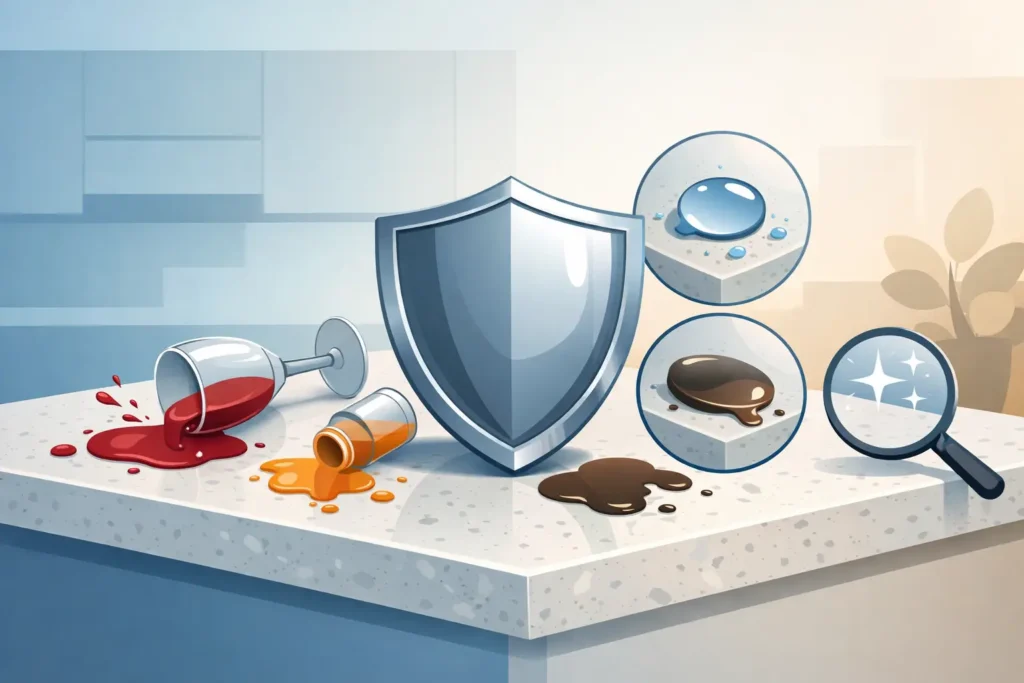
Red wine on a white island will get your attention fast. That is usually the moment people start asking about quartz countertop stain resistance and whether quartz really holds up better than granite, laminate, or butcher block. The short answer is yes, quartz is one of the best low-maintenance options you can put in a kitchen or bath, but it is not magic, and it helps to know where the limits are.
If you are comparing surfaces for a remodel in Indianapolis, stain resistance matters because real life is messy. Coffee rings, pasta sauce, cooking oil, makeup, food coloring, juice boxes, and cleaning products all end up on countertops. Most homeowners are not looking for a surface they have to babysit. They want something that looks sharp, cleans up easily, and does not turn every spill into a project.
How quartz countertop stain resistance actually works
Quartz countertops are engineered surfaces made from ground natural quartz mixed with resins and pigments. That mix is what gives quartz one of its biggest advantages – it is non-porous. In plain English, the surface does not have the tiny open pores that many natural stones do.
That matters because stains usually happen when a liquid gets into a material and lingers there. With quartz, common kitchen messes tend to stay on the surface instead of soaking in. So if you spill coffee in the morning or olive oil while cooking dinner, you usually have time to wipe it up without it leaving a mark.
This is one of the main reasons quartz has become such a popular choice for busy households, rental upgrades, and fast-turn remodels. You get the look of stone without the same level of ongoing maintenance. For a lot of homeowners, that is the sweet spot.
What quartz resists well
Quartz does a very good job resisting everyday household staining from things like coffee, tea, wine, soda, ketchup, mustard, peanut butter, salad dressing, and most bathroom products. Even darker substances that would make people nervous on lighter surfaces are usually not a big issue if cleaned up in a reasonable amount of time.
That is why quartz works so well in family kitchens, break rooms, and bathrooms that get heavy use. It is built for normal messes. You do not need special sealing appointments, and you do not need to panic every time somebody leaves a cup sweating on the counter.
For homeowners trying to stay on budget, that low-maintenance side matters just as much as appearance. A countertop can look great in a sample, but if it creates more upkeep than you want, it gets old fast.
Where stain resistance gets overstated
Now for the part that gets glossed over too often. Stain resistant does not mean stain proof.
Quartz is excellent against routine spills, but certain substances can still cause discoloration if they sit too long or if the wrong cleaner is used. Harsh chemicals are a common problem. Bleach, oven cleaner, paint removers, strong degreasers, and products with high alkaline or acidic content can damage the resin binders in quartz. When that happens, the issue may look like a stain, but it is really surface damage.
Heat can also complicate things. Quartz is not the best surface for direct heat exposure. A hot pan taken right off the stove can damage the resin, and once the surface is altered, it may become more likely to show marks or discoloration. So while heat is not a stain in the usual sense, it can create a problem that looks a lot like one.
Permanent marker, hair dye, nail products, and some craft materials also deserve caution. These are not typical kitchen spills, but when they happen, they can be tougher to remove than coffee or wine.
Quartz vs. granite for stain resistance
This is one of the most common comparison questions we hear. Granite is a natural stone, and while it is durable and beautiful, it is porous to varying degrees. That means granite usually needs sealing to help protect against stains. Some granites are denser than others, so performance can vary by color and slab.
Quartz is more predictable. Because it is engineered and non-porous, you are generally getting stronger built-in stain resistance without the sealing routine. If your top priority is easier maintenance, quartz usually wins that conversation.
That said, granite still has real advantages. It handles heat better, has one-of-a-kind movement and patterning, and many homeowners simply love the natural look. So the better choice depends on how you cook, how much upkeep you are willing to do, and what look you want in the room.
If you want a countertop that is easier for kids, tenants, or busy schedules, quartz is hard to beat. If you want natural character and do not mind occasional sealing, granite remains a strong option.
The biggest mistakes that hurt quartz countertop stain resistance
Most quartz problems do not start with spaghetti sauce. They start with cleaning habits.
Using the wrong products is the big one. People assume stronger cleaner means better cleaner, but quartz does best with mild soap, warm water, and a soft cloth for regular cleanup. If you keep hitting the surface with harsh chemicals, abrasive pads, or highly concentrated sprays, you can dull the finish or affect the resin.
The second mistake is letting problem materials sit too long. Again, normal food spills are usually fine. But if you leave hair dye, permanent marker, strong solvents, or sticky colored syrups on the surface for hours or overnight, you are taking a bigger risk.
The third mistake is skipping trivets and hot pads. Homeowners sometimes hear that quartz is durable and assume that means it can take anything. It is durable, but direct heat is still a weak spot.
How to clean quartz without causing issues
Daily cleaning is simple. Wipe the surface with a soft cloth or sponge, warm water, and a small amount of dish soap if needed. For dried-on messes, use a non-abrasive cleaner made for stone or quartz and a gentle cloth.
If something sticky is stuck on the surface, a plastic scraper can help lift it without scratching. Just do not go at it with anything metallic or overly aggressive.
For disinfecting, check that the product is safe for quartz and follow the directions. A lot of damage happens when cleaners are left sitting too long instead of being wiped away properly.
The good news is that quartz maintenance is easy compared to many alternatives. There is no sealing schedule, and routine care is straightforward. That is a big reason so many homeowners choose it when they want a sharp-looking kitchen without adding another item to the home maintenance list.
Does color matter for stain resistance?
In terms of actual resistance, not much. A white quartz top and a dark quartz top are both non-porous surfaces. But visibility is a different story.
Lighter quartz may show coffee, red sauce, turmeric, or makeup faster simply because there is more contrast. Darker quartz may hide those everyday messes better, but it can show dust, fingerprints, or water spots more easily. So when customers ask which color is more stain resistant, the honest answer is that the resistance is similar, but the surface may wear visually in a different way depending on the color and finish.
That is why selection matters. You are not just choosing a color you like in a sample. You are choosing how that surface will look on a Tuesday night with groceries on the counter and kids doing homework nearby.
Is quartz a good fit for busy Indianapolis homes?
For a lot of homes, yes. Quartz works especially well for homeowners who want predictable performance, easy cleanup, and no sealing. It is a strong fit for primary kitchens, bathroom vanities, office break rooms, and investment properties where durability and low maintenance both matter.
It is also a smart choice if you do not want to spend weeks chasing quotes and comparing slab yards on your own. A good countertop process should make the decision easier, not more confusing. That is a big part of why homeowners around Indy, Carmel, Fishers, Greenwood, Avon, and Westfield keep coming back to quartz. It solves a real problem. It looks good, performs well, and does not ask much from you afterward.
At Granite Networks Indy, we talk through these trade-offs every day with customers who want something that looks great but also makes sense for how they actually live. The best countertop is not the one with the fanciest sales pitch. It is the one that fits your budget, your habits, and the amount of maintenance you are willing to deal with.
If stain resistance is high on your list, quartz deserves a serious look. Just go into it with the right expectations. It handles normal life extremely well, but it still rewards basic care and common sense. Pick the right color, use the right cleaners, keep hot pans off the surface, and quartz will make day-to-day countertop ownership a whole lot easier.