
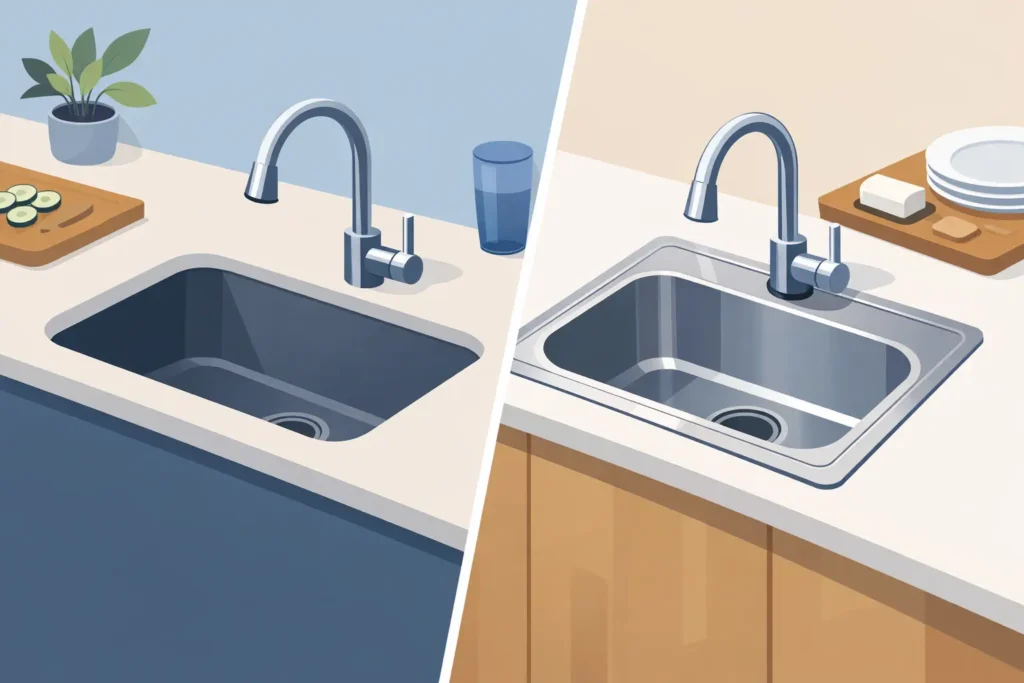
A sink choice can change how your entire countertop installation looks, cleans, and holds up over time. When homeowners ask us about undermount versus drop in sinks, they usually want a simple answer: which one looks better, costs less, and makes sense with granite or quartz? The honest answer depends on your countertop, budget, kitchen habits, and the condition of your cabinets.
For most new granite and quartz kitchen installations around Indianapolis, Carmel, Fishers, Greenwood, Avon, and Westfield, an undermount sink is the popular choice. But drop-in sinks still have a place, especially when budget, replacement timing, or countertop material makes them the smarter move.
Undermount Versus Drop In Sinks: The Main Difference
An undermount sink is installed beneath the countertop. The countertop edge is visible around the sink opening, and the sink is secured from below with brackets, adhesive, and proper support. There is no sink rim sitting on top of the counter.
A drop-in sink, sometimes called a top-mount or self-rimming sink, drops into a cutout from above. Its rim rests directly on the countertop and is sealed around the edge. It is a familiar setup because it works with many countertop materials and is often easier to replace.
That one installation difference affects cleaning, appearance, cost, and long-term maintenance.
Why Homeowners Choose Undermount Sinks
Undermount sinks give granite and quartz countertops a clean, finished look. Because the countertop runs right to the sink opening, the stone becomes the visual feature instead of a raised metal rim. This is especially noticeable with a large single-bowl stainless sink, a farmhouse-style setup, or a quartz color with movement worth showing off.
The biggest everyday advantage is cleanup. Crumbs, water, and food scraps can be wiped straight from the counter into the sink without catching on a rim. If you cook often, pack lunches, or have kids making a mess at the island, that small convenience adds up fast.
Undermount sinks also make the counter feel less cluttered. They are a strong fit for homeowners who want a modern kitchen, flippers updating an older property for resale, and commercial break rooms where easy cleaning matters.
There is a practical side to this choice, though. An undermount sink must be installed correctly. A heavy cast-iron, fireclay, or large workstation sink needs the right support below the counter. The fabricator also needs to finish the sink cutout cleanly and match the reveal style you want.
A positive reveal leaves a small portion of the sink edge visible. A negative reveal slightly overhangs the sink edge. A flush reveal lines up the countertop edge with the sink edge. Most homeowners do not need to get overly technical here, but it is worth discussing before fabrication because the cutout cannot simply be changed after the countertop is installed.
Best Countertops for an Undermount Sink
Granite and quartz are excellent materials for undermount sink installations. Both are rigid, durable, and able to support a properly installed sink system. Quartz is especially common in kitchens where homeowners want a smooth, consistent look and low day-to-day maintenance.
Natural granite also works very well, but it should be sealed as needed and kept in good shape around the sink area. Water standing at any sink seam for long periods is never a great idea, regardless of the countertop material.
Laminate is where the conversation changes. While special undermount options exist for some laminate systems, a standard undermount sink is generally not the go-to choice because the exposed core at the cutout can be vulnerable to moisture. In that situation, a drop-in sink is often the safer, more affordable answer.
When a Drop-In Sink Makes More Sense
Drop-in sinks do not get the same attention in kitchen inspiration photos, but they are not automatically the lesser choice. They are practical, widely available, and can make sense for plenty of real projects.
The rim covers the cut edge of the countertop, which can be useful when a cutout needs a little flexibility or when you are replacing an existing sink without changing the counters. Drop-in models also work well with laminate, tile, wood, and many older countertop setups.
Installation is usually more straightforward, and the sink itself may cost less than a comparable undermount option. If you are renovating a rental, refreshing a flip, updating a laundry room, or watching every line item in a budget, that matters.
A drop-in sink can also be easier to replace later. With an undermount sink, changing to a different size or shape may require new countertop work. With a drop-in sink, there is sometimes more room to work with because the rim covers the opening. That said, you still need to confirm the new sink’s required cutout dimensions before ordering anything.
The trade-off is cleaning. The raised rim creates a small edge where crumbs and moisture can collect. Caulk around the rim can eventually discolor, break down, or need replacement. It is not a major problem if you keep the area clean, but it is more maintenance than simply wiping directly into an undermount sink.
Cost: What Actually Changes the Price?
The sink style itself is only one part of the cost. Sink material, bowl size, accessories, cabinet modifications, plumbing work, and countertop fabrication all affect the final number.
An undermount installation can cost more because it requires polished cutout work, mounting hardware, labor, and careful alignment. A large granite composite, cast-iron, or fireclay sink may also require added cabinet support. If you are replacing counters and keeping an existing sink, it is important to verify that the sink is in good condition and compatible with the new layout before the templates are made.
Drop-in sinks can be a lower-cost route, particularly with standard stainless models. But a premium drop-in workstation sink with integrated accessories can still cost more than a basic undermount. Do not choose based on the installation label alone. Look at the full sink, countertop, and labor package.
At Granite Networks Indy, we help customers sort out these decisions while measuring and selecting stone, so there are fewer surprises when the project reaches fabrication and installation.
Think About Your Kitchen Habits, Not Just the Look
If your kitchen sees constant cooking, an undermount sink is usually worth serious consideration. The easy wipe-in cleanup and finished stone edge are hard to beat. It is also a strong choice if you are investing in new quartz or granite and want the sink area to match the quality of the countertop.
If you are updating a utility room, working with laminate, replacing a sink without replacing counters, or trying to keep an investment property project efficient, a drop-in may be the better call. It can still look clean and professional when installed well with a quality sink and fresh sealant.
Sink size matters just as much as mounting style. A deep single bowl is great for sheet pans and large pots, but some people prefer a double bowl for separating dishes from food prep. Consider where you place drying racks, how often you hand-wash cookware, and whether your base cabinet can accommodate the model you want.
Questions to Answer Before You Order
Before buying any sink, confirm the base cabinet width, sink dimensions, drain placement, faucet hole needs, and whether you want accessories such as a grid, cutting board, or colander. If you want a farmhouse sink, bring that up early. It often requires cabinet modifications and a very specific countertop cutout.
Also, do not assume every sink can be installed after the countertops arrive. For an undermount installation, the sink usually needs to be available before templating or fabrication so the cutout can be made to the exact specifications. This saves headaches, delays, and expensive last-minute changes.
The best sink is the one that fits your counter material, cabinet layout, and real day-to-day routine. Pick the option that makes your kitchen easier to use every morning, not just the one that looks best in a showroom photo.