
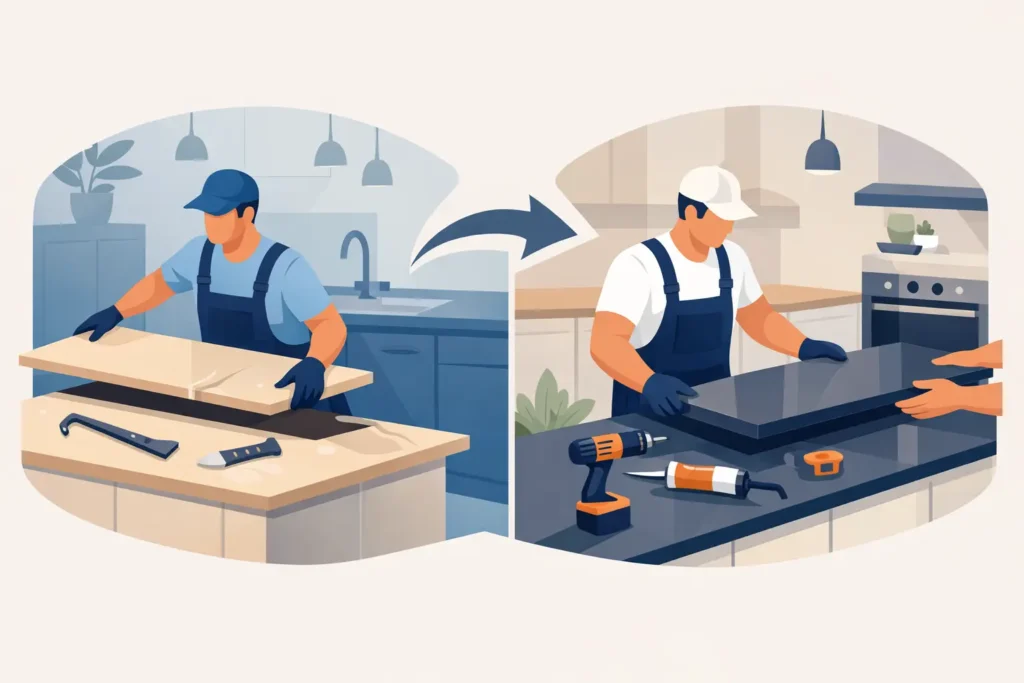
If you have ever started pulling up an old countertop and realized the sink, backsplash, plumbing, and cabinet level all matter at once, you already know this is not a casual weekend job. Learning how to remove and install kitchen countertops sounds simple until you get into seams, overhangs, cutouts, and the very real risk of cracking a new top before dinner.
That does not mean the process has to feel complicated. It just means you need to know where a homeowner can safely handle the work, where things usually go sideways, and when bringing in a local countertop crew saves money instead of adding cost.
How to remove and install kitchen countertops without costly mistakes
The first thing to understand is that countertop removal and installation are really two separate jobs. Removing an old laminate top is often straightforward. Removing granite, quartz, tile, or anything glued down hard can get heavy and risky fast. Installing a new top depends even more on the material. A butcher block top gives you some flexibility on site. Granite and quartz do not. Once stone is fabricated, there is not much room for adjustment.
That is why measurements come first, not demolition. Before anything gets unscrewed, disconnected, or pried loose, confirm the cabinet layout, sink size, appliance clearances, and finished dimensions. If the new countertop is being professionally fabricated, the old top often needs to stay in place until final measurements are confirmed. Tear it out too early and your kitchen is out of service longer than it needs to be.
Start with the material, because installation changes with it
Not all countertops come out the same way, and they definitely do not go in the same way.
Laminate is usually the easiest to remove. It is often screwed into the cabinets from below and may have a bead of caulk at the wall. Once the sink and plumbing are disconnected, the screws come out, the caulk line is cut, and the top can often be lifted free in sections.
Tile counters are messier. Demo usually means breaking tile, loosening mortar, and removing a heavy substrate underneath. There is dust, noise, and a good chance of minor wall repair afterward.
Granite and quartz are where homeowners need to slow down. Stone tops are heavy, awkward, and brittle in the wrong places, especially around sink openings and narrow spans. A slab can survive years of use and still crack during removal if it is lifted unevenly. If you are hoping to save the top for reuse, removal needs extra care. If you are replacing it, safety still matters because damaged cabinets, flooring, and backsplashes can turn a countertop project into a bigger remodel.
Removing the old countertop
Start by clearing everything off the counters and inside the sink base cabinet. Shut off water lines and disconnect the plumbing. If you have a disposal, power should be off before touching anything under the sink. Drop-in sinks are usually clipped to the underside of the top. Undermount sinks on stone can be secured with clips, brackets, adhesive, or a combination.
Next, cut the caulk line where the countertop meets the wall, side splash, or cabinets. This step matters more than people think. If you skip it and start prying, drywall paper, paint, and even backsplash tile can come with the top.
Then look underneath for screws, corner blocks, adhesive, or brackets holding the countertop to the cabinets. Laminate tops are usually fastened mechanically. Stone tops may be set with silicone or construction adhesive in key spots instead of lots of screws.
Once everything is detached, lift carefully and evenly. With laminate, two people can often manage it. With granite or quartz, this is not a one-person move and usually not a two-person move either, depending on size. Large sections need support across the full span, not just at the ends. If a stone top has a long run, sink cutout, or bar overhang, carrying it wrong is the fastest way to break it.
If your cabinets are staying, removal is also the time to inspect them. Look for water damage near the sink base, loose rails, out-of-square corners, and any wobble. New countertops only install as well as the cabinet base below them.
Prep work before the new top goes in
This is the part people rush, and it is where a lot of installation problems begin.
Cabinets need to be level, secured to each other, and anchored well to the wall. A small hump or dip can create a stress point under stone. Quartz and granite need consistent support. If cabinets are out of level, shimming happens before the countertop arrives, not after a crack appears.
You also need to confirm that appliances still fit the finished opening. Slide-in ranges, dishwashers, and farmhouse sinks can create clearance issues if dimensions are off by even a little. Backsplash plans matter too. If the wall is wavy and you are expecting the countertop to sit perfectly tight against it, you may need a scribe fit or plan for a backsplash to cover slight irregularities.
For homeowners in Indianapolis, Carmel, Fishers, Greenwood, Avon, and Westfield, this is usually where the value of a measure-and-install service becomes obvious. It saves you from guessing on overhang depth, sink reveal, seam placement, and whether your walls are as straight as they look.
Installing the new countertop
If you are installing a wood or laminate top, the job is more forgiving. The countertop is dry-fit first, checked for fit against walls and cabinets, then secured from below according to the manufacturer or fabricator instructions. Openings for sinks and faucets may be cut on site depending on the material and setup.
Stone installation is different. Granite and quartz are typically templated, fabricated, delivered, and installed as a finished product. The install team dry-fits each piece, checks seam alignment, verifies overhangs, and makes sure the top is fully supported. Small shims may be used where needed, but this is about fine-tuning, not fixing major cabinet problems.
Then the pieces are set with adhesive at key support points. Seams are pulled tight, leveled, and filled with color-matched epoxy or resin. Sinks are mounted according to the sink type and the stone fabricator’s method. Faucets, plumbing reconnection, and cooktop installation usually follow after the top is secure.
One thing homeowners often miss is that stone installation is as much about planning as lifting. Seam placement affects appearance and strength. Sink cutouts affect stability during transport. Even getting a large island from the driveway into the kitchen can be a challenge if turns are tight or entries are narrow.
When DIY makes sense and when it does not
If you are replacing a basic laminate countertop in a utility space, rental, or budget remodel, DIY can be reasonable if you have the tools and patience. The same goes for some butcher block projects, especially in straight runs with simple sink setups.
If you are dealing with granite or quartz, the question is usually not whether a handy person can help. It is whether the risk is worth it. Stone mistakes are expensive. A bad measurement can ruin a fabricated piece. A weak cabinet corner can create future stress. A rushed sink install can lead to leaks, cabinet damage, or a failed mount.
That is why many homeowners and flippers choose a company that handles measuring, stone selection, fabrication coordination, old top removal, and install in one process. It is faster, pricing is clearer, and there is a lot less finger-pointing if something needs adjustment.
Common problems that slow down countertop jobs
Most delays come from a few familiar issues. Cabinets are not level. The sink or faucet was ordered in the wrong size. The backsplash removal damaged the wall more than expected. The old top was removed before final measurements were taken. Or the homeowner assumed every slab of granite or quartz looks exactly like the sample.
That last one matters. Natural stone varies. Quartz is more consistent, but even then color, movement, and finish should be viewed on actual material, not just a small swatch. A good installer or supplier helps you pick with the real kitchen in mind, not just a warehouse label.
At Granite Networks Indy, that hands-on part is a big reason customers call us. We take the hassle out by helping people measure correctly, choose the right material, avoid showroom runaround, and get the job installed without unnecessary drama.
What to expect on installation day
A solid install day should feel organized. Access paths are protected, cabinets are checked one more time, tops are carried in with enough manpower, and fit is verified before anything is permanently set. You may need to wait before reconnecting plumbing or using certain areas depending on adhesive cure times and sink setup.
Do not expect a magic fix for structural issues that were skipped earlier. If cabinets are weak or walls are badly out, that can still affect the final result. Good installers can work through minor real-world issues. They cannot erase bad prep.
If you are trying to figure out how to remove and install kitchen countertops, the honest answer is this: some parts are manageable, but the result depends on planning more than brute force. The smartest move is not always doing every step yourself. Sometimes it is knowing which part to own and which part to hand to a crew that does this every day. A kitchen is too central to your home to gamble on preventable mistakes.