
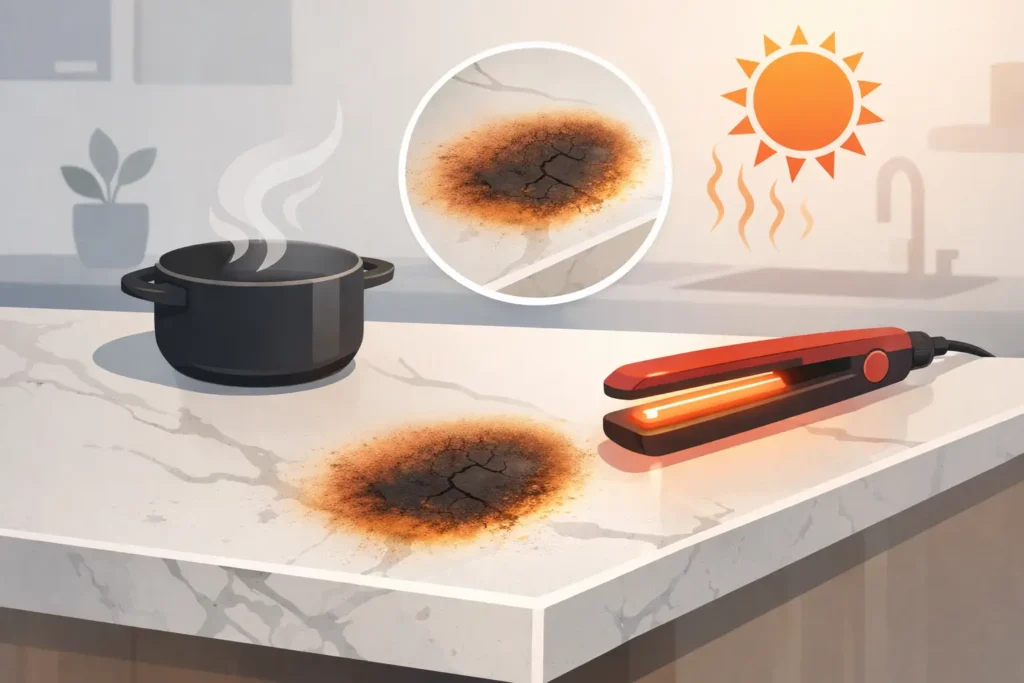
Set a hot pan straight from the stove onto quartz, and the problem usually does not show up like a dramatic burn mark right away. More often, quartz countertop heat damage starts as a dull spot, slight discoloration, or a change in sheen that makes one section look off compared to the rest of the top. That is what catches homeowners by surprise. Quartz is tough, but it is not built to handle direct high heat the same way many people assume.
What quartz countertop heat damage actually looks like
Quartz countertops are engineered surfaces made from crushed quartz mixed with resins and pigments. The stone content is what gives quartz its strength, but the resin is the part that creates the heat issue. When that resin gets exposed to too much direct heat, it can discolor, scorch, or weaken.
In real kitchens, heat damage usually shows up as yellowing, a cloudy patch, a white haze, or a spot that looks less polished than the surrounding surface. In worse cases, you can see a crack develop from sudden thermal shock. Sometimes the top does not crack at all, but the finish still changes enough that you notice it every time the light hits that area.
That is why quartz gets a reputation for being low maintenance but not heat proof. Both parts are true. It is easier to live with than many natural stones in day-to-day use, but it still needs basic protection from hot cookware.
Why quartz countertop heat damage happens
The short version is simple. Quartz itself handles heat better than the binding materials used to make the slab. The resin can react when you put something very hot directly on the surface, especially for more than a few seconds.
A crockpot, air fryer, electric griddle, toaster oven, or hot skillet can all create trouble spots over time. A pan fresh from a 400-degree oven is the obvious risk, but small appliances are a more common problem because people leave them in one place for long stretches while heat builds underneath. We see that issue in kitchens all the time.
There is also an it depends factor here. Not every quartz brand performs exactly the same, and not every color shows damage the same way. Lighter colors may show yellowing more clearly. Darker colors may show haze, faded sheen, or ring marks more easily. Patterned surfaces can hide minor changes better than solid colors, but the damage is still there.
Is quartz more likely to burn than granite?
This is one of the most common questions during countertop shopping, and the honest answer matters. Granite usually handles direct heat better than quartz because it is a natural stone without resin throughout the slab in the same way engineered quartz has. That does not mean granite should be treated carelessly, but if heat resistance is high on your priority list, granite has an edge.
That said, quartz still makes sense for a lot of Indianapolis-area homeowners because it is consistent in color, easy to maintain, and great for busy kitchens. You just need the right expectations. If you want a surface that looks clean and modern and does not require sealing, quartz is a strong option. If you regularly move hot cast iron from oven to counter, you need to build trivet use into your routine.
The biggest heat mistakes homeowners make
Most quartz damage is not caused by one freak accident. It usually comes from everyday habits that seem harmless until the surface changes.
The first mistake is assuming “heat resistant” means “hot pan safe.” Those are not the same thing. Many countertop materials can tolerate some heat exposure in a room, but direct contact from a very hot object is different.
The second mistake is parking appliances in one spot and using them there every day. Coffee makers are usually fine, but air fryers, toaster ovens, slow cookers, and electric skillets can trap heat against the countertop or backsplash area. Over time, that repeated heat can affect the resin.
The third mistake is trusting that because no mark appeared the first time, the surface is fine. Heat damage can build gradually. One day the reflection looks uneven, and then you realize that area has changed.
How to prevent quartz countertop heat damage
The good news is prevention is easy and cheap. Use trivets, hot pads, or pan stands every time you set down hot cookware. Keep a few in the kitchen where you actually cook, not tucked away in a drawer you never open.
Give heat-producing appliances breathing room. If you use an air fryer or toaster oven often, place it where heat can vent properly and do not let it blast directly onto the countertop surface or wall area for long periods. A protective mat can help, but it should be a product intended for heat protection, not just a decorative pad.
It also helps to think about your kitchen habits before you choose your material. If your household cooks hard every day, uses cast iron often, or tends to move fast and set hot items down wherever there is space, that is worth discussing before installation. A good countertop recommendation is not just about color. It is about how you actually live.
Can heat-damaged quartz be repaired?
Sometimes, but not always.
Minor surface issues may be improved depending on the severity and the finish, but quartz is not like a natural stone that can always be polished and brought back evenly. If the resin has discolored or scorched, the damage may be permanent. If there is a crack from thermal shock, repair options depend on the location, the pattern, and how visible the fix will be.
This is where homeowners get frustrated, because they expect a simple buff-out solution. In some cases, there is no invisible repair. A small damaged section might be less noticeable with professional help, but a perfect match is not guaranteed. If the area is large or in a highly visible section of the kitchen, replacement can end up being the cleaner answer.
That is also why prevention matters so much more than repair with quartz. A ten-dollar trivet is a lot cheaper than living with a burn mark near your range for the next ten years.
Will quartz countertop heat damage be covered under warranty?
Usually, direct heat damage is not covered.
Most quartz manufacturers have clear care guidelines that tell you not to place hot pots, pans, or heat-generating appliances directly on the surface. If the damage lines up with misuse, warranty coverage is unlikely. That catches some buyers off guard because they hear “durable” and assume that includes anything a kitchen can throw at it.
This is one reason clear education matters during the buying process. A countertop should fit your style, your budget, and your actual routine. If a material needs a little more care in one area, it is better to know that before install day than after the first holiday meal.
What to do if you already see damage
First, stop using that section for hot items right away. If a small appliance is causing the issue, move it. Clean the area with a quartz-safe cleaner so you can see the damage clearly and rule out simple residue.
Then have a professional evaluate it. Pictures help, but an in-person look is better when possible because finish changes and discoloration can be hard to judge from a phone photo. The goal is to determine whether the issue is cosmetic, structural, or likely to spread.
If replacement becomes the best option, that does not always mean replacing the entire kitchen. Sometimes one section can be addressed depending on the layout, seams, and material availability. That is where working with a local company that handles measuring, material guidance, and installation coordination saves a lot of back-and-forth.
Is quartz still a good choice for kitchens?
Absolutely, for the right homeowner.
Quartz is still one of the best-selling countertop materials because it checks a lot of boxes. It looks sharp, stays consistent from slab to slab, and keeps maintenance simple. For many families, that matters more than maximum heat tolerance. You just need to use common sense with hot items.
If you want help sorting out whether quartz or granite makes more sense for your kitchen, that conversation should be practical, not pushy. At Granite Networks Indy, that is exactly how we approach it. We help people look at the real trade-offs, keep pricing straightforward, and avoid paying for more stone than the job actually needs.
A countertop should make your kitchen easier to live with, not give you another thing to worry about. If you treat quartz like a quality finished surface instead of a landing pad for red-hot cookware, it holds up beautifully and looks great for years.