
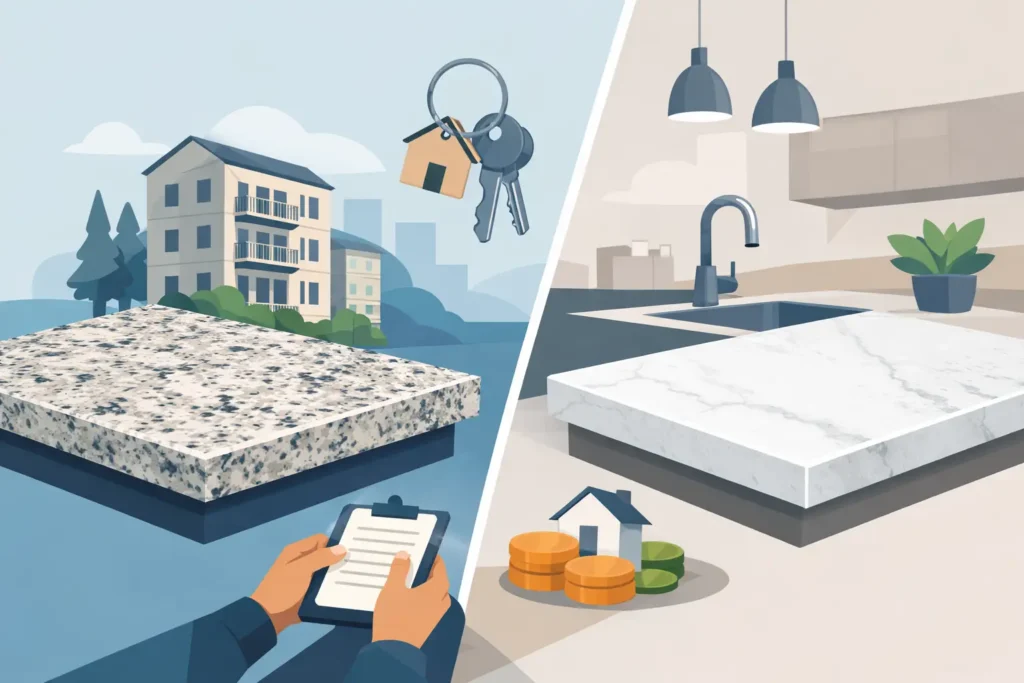
A rental kitchen does not need to win design awards. It needs to hold up, look clean, and make sense on the numbers. That is why the granite or quartz for rentals question comes up so often with landlords, flippers, and property managers around Indianapolis. The right answer depends on who will use the space, how long you plan to hold the property, and how hard you want that countertop to work for your budget.
If you own a higher-end rental in Carmel or Fishers, your decision may lean one way. If you are turning a more price-sensitive unit in Greenwood, Avon, or Indy proper, it may lean the other. There is no one-size-fits-all answer here, but there is usually a smart answer once you look at durability, maintenance, appearance, and replacement cost together.
Granite or quartz for rentals: what matters most
Most rental owners start by asking which one is cheaper. That matters, of course, but it should not be the only thing driving the choice. A countertop in a rental is not just a finish. It is part of the turnover cycle, the tenant experience, and the long-term maintenance plan.
Granite is a natural stone, so every slab has variation. It can give a rental a more upscale, one-of-a-kind look, especially in kitchens where you want to raise the feel of the whole space without rebuilding everything else. Quartz is engineered, more consistent in pattern, and usually easier to match if you are doing multiple units or want a cleaner, more uniform look.
For rentals, the biggest questions are pretty simple. How likely is the surface to stain or chip? How much maintenance will it need between tenants? Will it help the unit rent faster? And if something goes wrong, how painful is the repair or replacement?
When granite makes sense in a rental
Granite can be a very solid choice for rentals, especially if you are targeting tenants who expect something better than builder-grade finishes. It has strong visual appeal, handles heat well, and gives a kitchen a real-stone look that many renters notice right away.
In a single-family rental or a nicer townhome, granite can help the property feel more premium without pushing you into luxury pricing on every other finish. It also works well if you are updating an older kitchen and want to add value without making everything look overly modern.
That said, granite does require sealing over time. Some colors and patterns are denser and less absorbent than others, but natural stone is still natural stone. In a rental, that matters. If a tenant leaves cooking oil, wine, or cleaner sitting too long, granite can stain if it has not been sealed properly.
This does not mean granite is a bad choice. It means the specific stone matters, and so does the way the project is planned. A busy, heavily speckled granite often hides crumbs, light wear, and minor messes better than a cleaner, more uniform pattern. For many landlords, that is a real advantage.
When quartz is the better fit
Quartz is often the easier recommendation for rentals because it is non-porous, low maintenance, and consistent. You do not need to seal it, and it generally holds up well to everyday tenant use. For owners who want fewer maintenance calls and fewer questions after installation, quartz checks a lot of boxes.
It also fits well in properties where you want a fresh, updated look that feels clean and current. White, gray, and lightly veined quartz styles are popular because they photograph well for listings and help older kitchens feel more modern.
The trade-off is that quartz is not indestructible. It can chip on edges, especially around sink cutouts or corners, and it does not love excessive heat. A tenant who sets a hot pan directly on the surface can damage it. That is not an everyday disaster, but it is worth thinking about if you are choosing surfaces for a unit where people may not be careful.
Quartz also tends to show some messes more quickly, depending on the color and pattern. A bright white quartz can look amazing in photos, but in a busy rental it may show spills, crumbs, and scuffs faster than a darker or more active granite pattern.
Cost is not just the material price
This is where a lot of owners get tripped up. They compare granite and quartz as if the only issue is price per square foot. Real rental math is a little different.
You have to think about installation, waste, sink cutouts, removal of old tops, and whether you are being pushed into buying more material than you need. You also need to think about turnover cost. If one surface saves you maintenance over the next few years, that has value. If another one helps you hit a better rental rate or lease faster, that has value too.
For example, a landlord doing one kitchen in a mid-range duplex may decide granite is the better move because it gives a strong look at a competitive price. A flipper doing several units may prefer quartz because the consistency makes selection easier and the maintenance is simpler after the sale. A property owner with long-term hold plans may choose whichever option gives the best balance of durability and visual appeal for that neighborhood.
That is why a square-foot pricing model matters. If you are only paying for what you actually need instead of getting boxed into a full slab purchase, the decision becomes much more practical.
Best use cases for granite vs quartz in rentals
Granite tends to work best when you want natural character, stronger heat resistance, and a little more visual richness for the money. It is especially useful in single-family rentals, nicer rehabs, and units where you want the kitchen to stand out without overspending.
Quartz tends to work best when you want a straightforward, low-maintenance surface with a clean look and predictable results. It is a strong option for newer-style rentals, townhomes, and properties where ease of upkeep matters more than the uniqueness of natural stone.
If you are furnishing a higher-end rental, either one can work. At that level, the decision often comes down to the overall design and what kind of renter you are trying to attract. If you are dealing with a basic turnover on a strict budget, the smarter move is usually the one that gives you durability without creating a future maintenance headache.
The rental market matters more than personal taste
A lot of owners pick countertops the same way they would for their own house. That is understandable, but rentals need a different filter. Your favorite look is not always the best business decision.
Think about your tenant base. Are they looking for a polished, modern kitchen? Are they comparing your place to newer builds? Or are they mostly focused on rent price, location, and general cleanliness? Countertops should support the value of the property, not overshoot it.
In many Indianapolis-area rentals, the best choice is the one that looks upgraded but not flashy. Neutral colors, practical patterns, and durable edges usually make more sense than trendy picks that may date quickly or show every bit of wear.
How to choose without wasting time
If you are still stuck on granite or quartz for rentals, the fastest way forward is to stop thinking in general terms and look at your actual project. What is the property type? What is the neighborhood? What is your budget range? How quickly do you need the job done? Are you doing one kitchen or several?
Once you answer those questions, the material decision gets easier. In many cases, owners are not choosing between a good option and a bad option. They are choosing between two good options that fit different goals.
That is why hands-on guidance matters. You want someone who can look at your measurements, explain the pricing clearly, help you choose the right stone at the warehouse, and keep the process moving. That is especially true when you are turning a rental and do not have time to spend all week bouncing between showrooms.
Granite Networks Indy works with a lot of owners in exactly this spot. They want a countertop that looks good, performs well, and does not turn into a complicated project. That is the right mindset.
So which one should most landlords choose?
If you want the safest broad recommendation, quartz usually wins for rentals because of the lower maintenance and consistent appearance. It is easy to understand, easy to clean, and easy to match to a wide range of cabinet and flooring choices.
But granite is far from a second-place option. In the right rental, especially where you want a stronger visual upgrade at a competitive price, granite can be the smarter buy. It may even wear more gracefully in some settings, depending on the color and pattern you choose.
The best rental countertop is not the one that sounds best in a blog post. It is the one that fits your unit, your tenant, and your budget without creating extra problems six months from now. If you keep that standard in front of you, the decision gets a whole lot simpler.
A good rental upgrade should make the property easier to lease and easier to own. Pick the surface that does both.